
In India, formal or traditional educational systems have never acknowledged skills or experience acquired through employment or work. The introduction of NEP 2020 is set to bring a change in this regard. NEP 2020 advocates for an approach to education that is more flexible and places greater emphasis on skill development and vocational training. Additionally, it promotes lifelong learning for professionals, opening doors to degrees, certificates, and diplomas they can pursue without taking a break from their careers.
Here, Recognition of Prior Learning (RPL) is crucial. It is a feature of the National Credit Framework (NCrF) in accordance with the NEP 2020 that enables people to use examinations to turn previously acquired knowledge or experience into credits. This is revolutionary for professionals seeking to advance their skills.

What is Recognition of Prior Learning (RPL)?
The process of assessing and recognizing the experience, skills or knowledge acquired outside of traditional educational systems by individuals is known as Recognition of Prior Learning. RPL enables people to receive formal recognition for the skills they have acquired, whether through years of employment, projects, volunteer work, or even independent studies.
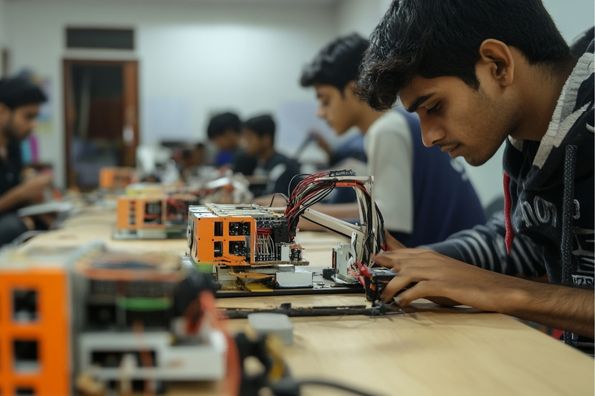
For example, RPL offers the opportunity to have your 10 years of experience as an electrician verified and then certified through examinations and evaluations. even if you have never had a formal certification.
RPL also allows you to demonstrate your abilities and obtain a qualification more quickly, without committing to a lengthy course to study what you already know.
How RPL Benefits Professionals
- Saves Time and Money: RPL saves both time and money. The opportunity to demonstrate what you already know and earn credits reduces the time required to complete a program. This ensures fast pace advancement in your career along with learning. Additionally, because of the reduction in time to complete the program, the tuition fees also are much lower as compared to other regular degree/diploma programs.
- Enhances Employability: If you are working in the industry without a PG degree or require a certificate for a particular skill set, RPL can be a great solution for you. It helps professionals to get that degree or the skill certificate in less time while still being in their present job. This also makes them more competitive in the job market.
- Upgrades Skills for Career Growth: Suppose you are an IT professional. You have years of experience in programming. However, you want to upskill yourself and learn a new programming language. RPL would help you to earn credits for your experience till date through assessments and also update your existing skills and add to your qualifications.
The Role of NEP and NCrF
RPL is a key component of the inclusive and flexible education routes that are highlighted by India's National Education Policy 2020 (NEP 2020). The NEP acknowledges that learning and education shouldn't be limited to age- or classroom-specific settings. The NEP recognizes the necessity of incorporating lifelong learning, prior learning, and job experience into formal education institutions by providing flexible learning methods.
The National Credit Framework is one of the NEP's most significant initiatives (NCrF). It offers a thorough approach for identifying different types of learning, such as academic, professional, and experiential learning. People can obtain credits for their prior education and work experience through NCrF, which can then be applied toward official certifications.
In addition to increasing employability, this promotes lifelong learning and increases accessibility to education for working professionals.
RPL: How It Works
RPL involves the following steps:
- Assessment/Examination: Provide evidence of any skill or experience that you have acquired through years. This is generally done through examinations, demonstrations, interviews, or even by furnishing previous work samples.
- Evaluation: Following the RPL methodology and other statutory criteria, examiners will assess your evidence, interview or demonstration.
- Recognition: If you are able to qualify the assessment process, you are eligible for the credits and certification of the same.
For example, suppose you are a graphic designer with no formal certification about the same. You have 5 years of experience and have a great portfolio to showcase. Through RPL, you can present your portfolio as evidence, go through the assessment process and receive certification on the same.
RPL in Foreign Nations
| Country | Impact of RPL |
| Australia | As of 2020, 31% of vocational education and training (VET) students took up courses that recognized prior learning through RPL. |
| Finland | More than 30% students in vocational education use some form of RPL to get their skills recognized. |
| Canada | RPL recipients were 40% more likely to complete educational programs than non-RPL learners. |
| South Africa | 70% of students choosing RPL secured employment within 12 months of certification. |
| New Zealand | 25% of students in tertiary education who went for RPL completed their qualifications faster |

RPL in India
- Workers who obtained RPL certification saw a 15-20% rise in employability, according to a 2022 NSDC report.
- Under this flagship scheme of the Indian government, RPL has been a critical component since its launch in 2015. As of 2023, over 5.5 million candidates have been certified through RPL programs.
- RPL is an important component of the Pradhan Mantri Kaushal Vikas Yojana (PMKVY). Through this initiative, more than 5.5 million applicants have received certification as of 2023.
- Through its RPL efforts, the Automotive Skills Development Council (ASDC) qualified approximately 200,000 workers.
- As part of their corporate training initiatives, Larsen & Toubro, for instance, trained nearly 20,000 construction workers through RPL.
- A 2021 evaluation of PMKVY’s RPL component by NSDC highlighted that the program has been particularly effective in bridging the gap between the informal and formal sectors. It found that RPL is helping to formalize the workforce, with 70% of participants gaining more job security or better employment opportunities after certification.
- According to NSDC's 2021 assessment of PMKVY, 70% of participants reported having higher job security or chances for employment following certification.
RPL and Upskilling in the Modern Workforce
In an increasingly technologically advanced environment, professionals need to continuously improve their skill sets. In this process, RPL is essential. It enables workers to expand on their prior knowledge and adjust to changing needs in their industry.
Furthermore, RPL is an appropriate fit for the contemporary upskilling strategy. With the growth of online learning and flexible learning pathways, professionals can now obtain certification more rapidly and advance in their jobs without having to spend years in formal training.
In accordance with these provisions, The Medhavi Skills University (MSU) has introduced the Accelerated Skill MBA for working professionals with 3 years of minimum work experience.
This program is designed as per the guidelines of NEP 2020. It has a futuristic curriculum combining the best features of top online MBA programs, traditional MBA programs and executive MBA programs.
It also takes work experience into consideration and converts it into credits through assessments. This allows professionals looking for top online MBA programs or executive MBA programs to complete their MBA within 15 months.
It is a UGC recognized work integrated, regular, full-time and fast-track MBA for working professionals which is equivalent to any other 2-year MBA program in India offering two Government of India recognized skill certificates.
As an ideal MBA for working professionals it turns experience into qualifications bridging the gap between industry and academia, helping professionals to grow and industries to innovate.