Choosing the right course after 12th is one of the most important decisions for students interested in science, technology, and computing. Among the most popular options are B.Tech, B.Sc, and BCA. Each course offers unique learning experiences, career opportunities, and pathways for higher education.
However, many students find themselves confused when comparing these programmes. Understanding the differences in curriculum, career prospects, and industry relevance can help students make a more informed decision based on their interests and goals.
In this blog we will discuss which course you should choose after 12th.
Overview: B.Tech vs B.Sc vs BCA: Which Course Should You Choose After 12th?
B.Tech, B.Sc, and BCA are all undergraduate programmes, but they differ significantly in their focus and outcomes.
B.Tech | B.Sc | BCA |
B.Tech is an engineering degree that emphasizes technical knowledge, problem-solving, and application of engineering principles. It is ideal for students interested in software development, engineering, and technology innovation. | B.Sc is a science-oriented degree that focuses on theoretical and analytical understanding of a subject. Students can specialize in fields such as Computer Science, Mathematics, Physics, Data Science, or Biotechnology. | BCA is a professional degree focused on computer applications, software development, and information technology. It is designed for students who want to build careers in the IT industry without pursuing engineering.
|
Eligibility Criteria for B.Tech, B.Sc, and BCA
The eligibility requirements for these programmes vary depending on the institution and specialization.
B.Tech: To pursue B.Tech, students must typically complete 12th with Physics, Chemistry, and Mathematics from a recognized board. Many institutions also require entrance examination scores.
B.Sc: These programmes generally require students to complete 12th in the science stream. Subject requirements may differ depending on the specialization chosen.
BCA: To get admission into BCA, eligibility after 12th varies across institutions. While many universities accept students from science, commerce, and arts backgrounds, some may require Mathematics as a subject at the school level.
Students should always verify programme-specific requirements before applying.
Course Duration and Curriculum Comparison
All three programmes are undergraduate degrees, but their curriculum structure differs significantly.
B.Tech is typically a four-year programme that combines theoretical learning with laboratory work, projects, and engineering applications. Students study programming, software engineering, networking, artificial intelligence, and other technical subjects depending on their specialization.
B.Sc is generally a three-year programme focused on scientific concepts, analytical skills, and subject specialization. Computer Science students, for example, study programming, databases, algorithms, and mathematics along with foundational scientific subjects.
BCA is usually a three-year programme designed around software applications and IT systems. The curriculum covers programming languages, web development, database management, networking, and software development practices.
While B.Tech provides broader engineering exposure, BCA focuses more directly on software applications, and B.Sc emphasizes academic and scientific foundations.
Skills You Gain in Each Course
The skills developed through these programmes depend on their academic focus and learning approach.
B.Tech students typically gain engineering problem-solving abilities, technical design skills, programming expertise, and project management capabilities. The programme develops a strong understanding of technology implementation and innovation.
B.Sc students develop analytical thinking, research capabilities, mathematical reasoning, and subject-specific expertise. The programme is particularly beneficial for students interested in higher studies, research, or specialized scientific careers.
BCA students build practical IT skills, including software development, coding, database management, web technologies, and application development. The course focuses on industry-relevant technical skills that are widely used in the IT sector.
Institutions such as Medhavi Skills University further strengthen these skills through work-integrated and industry-oriented learning models.
Career Opportunities After B.Tech, B.Sc and BCA
Career opportunities vary depending on the chosen course and specialization.
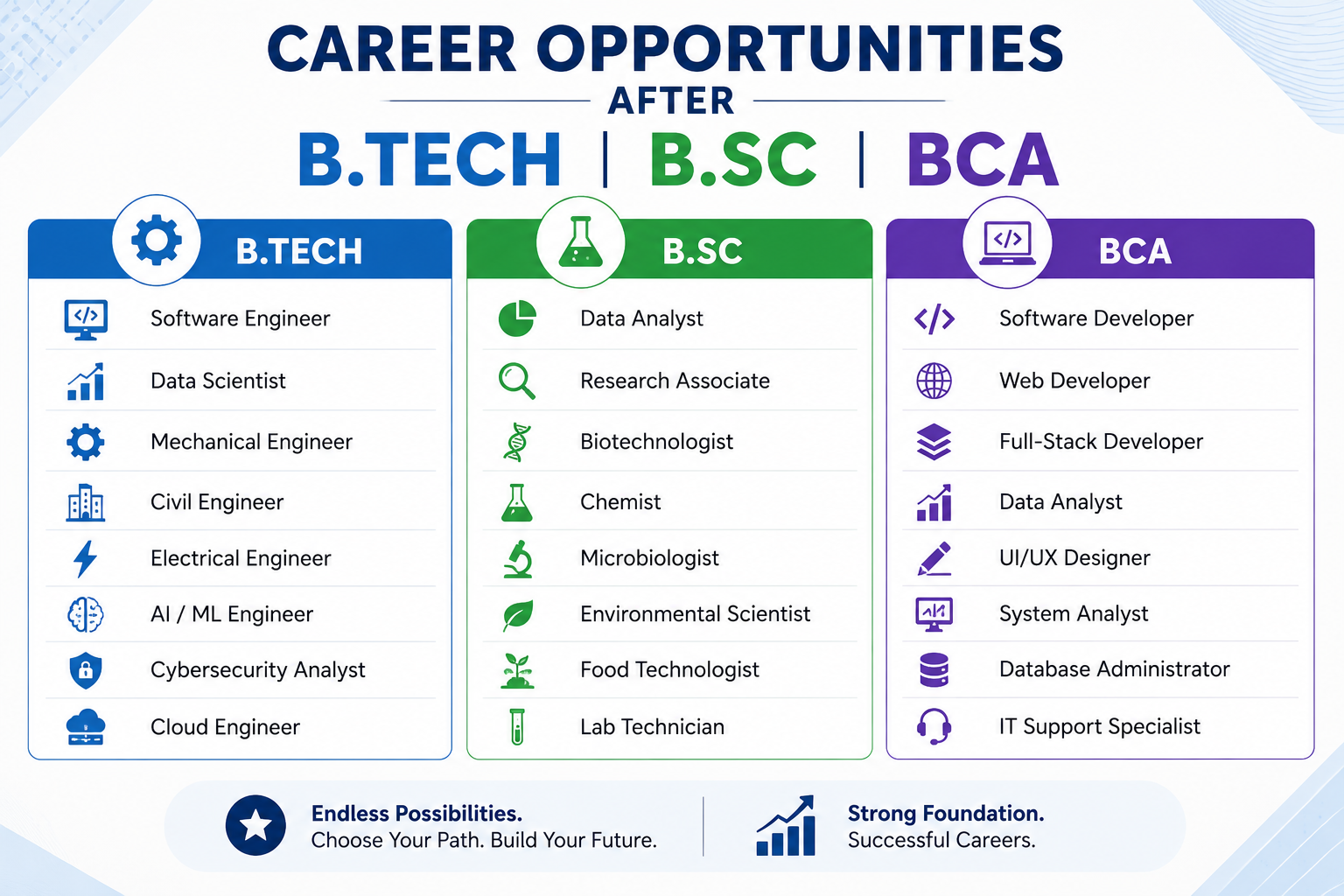
Career Opportunities After B.Tech
B.Tech graduates are equipped with technical, analytical, and problem-solving skills that make them valuable across engineering and technology-driven industries. The degree also provides opportunities to pursue higher studies, research, or management roles.
Some popular career options include:
- Software Engineer
- Data Scientist
- Mechanical Engineer
- Civil Engineer
- Electrical Engineer
- AI / ML Engineer
- Cybersecurity Analyst
- Cloud Engineer
Career Opportunities After B.Sc
B.Sc graduates can explore diverse opportunities depending on their specialization. The programme builds a strong academic foundation and is often preferred by students interested in research, scientific fields, or higher education.
Some common career options include:
- Data Analyst
- Research Associate
- Biotechnologist
- Chemist
- Microbiologist
- Environmental Scientist
- Food Technologist
- Lab Technician
Career Opportunities After BCA
BCA graduates typically pursue careers in the IT and software industry. The programme focuses on practical computing skills, making graduates suitable for a variety of technology-related roles.
Some popular career options include:
- Software Developer
- Web Developer
- Full-Stack Developer
- Data Analyst
- UI/UX Designer
- System Analyst
- Database Administrator
- IT Support Specialist
As industries continue to digitize, demand for professionals with technology and computer science skills is expected to remain strong across all three pathways.
Computer Science & BCA: Skills, Learning and Career Opportunities
Conclusion
The choice between B.Tech, B.Sc, and BCA depends on individual interests, career goals, and learning preferences. Students who are interested in engineering and technology innovation may find B.Tech the most suitable option. Those who enjoy scientific exploration and academic specialization may benefit from a B.Sc degree, while students seeking a direct pathway into the IT industry may prefer BCA.
Rather than focusing solely on degree titles, students should evaluate curriculum structure, industry relevance, practical exposure, and future career opportunities. Universities that emphasize skill development and real-world learning can help students gain a competitive advantage in today's job market.