
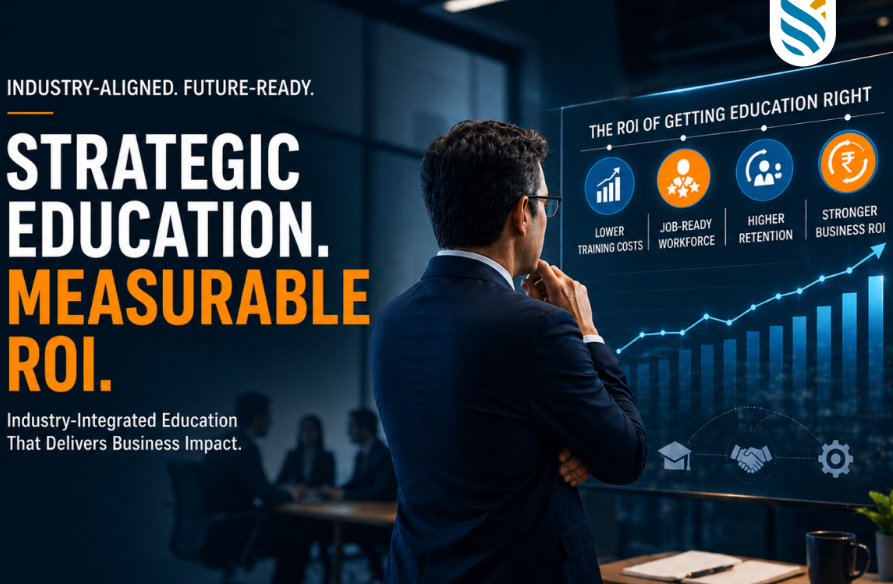
Amid accelerating technological change, the gap between hiring talent and deploying job-ready employees is widening. Enterprises are investing more in recruitment, onboarding, and corporate training programs, but challenges such as mismatched skill sets, delayed productivity, and low retention still surface early in the employee lifecycle.
The frustrating part is not the investment. It is that the investment keeps going into the same place - fixing after hiring what was never built before it. Every year, the onboarding budget grows. The retraining cycles repeat, and so does the disconnect in what skills graduates bring and what their roles actually demand.
Simply put, industry-integrated education is emerging as a strategic approach for enterprises to redefine how talent should be employed, deployed, and retained more effectively, all while generating measurable ROI. Now, the conversation has moved from “does it work?” to “how do we make it work predictably?”
The Hidden Cost of Conventional Workforce Development
Most enterprises still count on a linear talent model: hire graduates, train them internally, and wait for productivity to stabilise. While familiar, the corresponding costs don’t always show up in obvious ways; instead, they build quietly across each batch of hires over time.
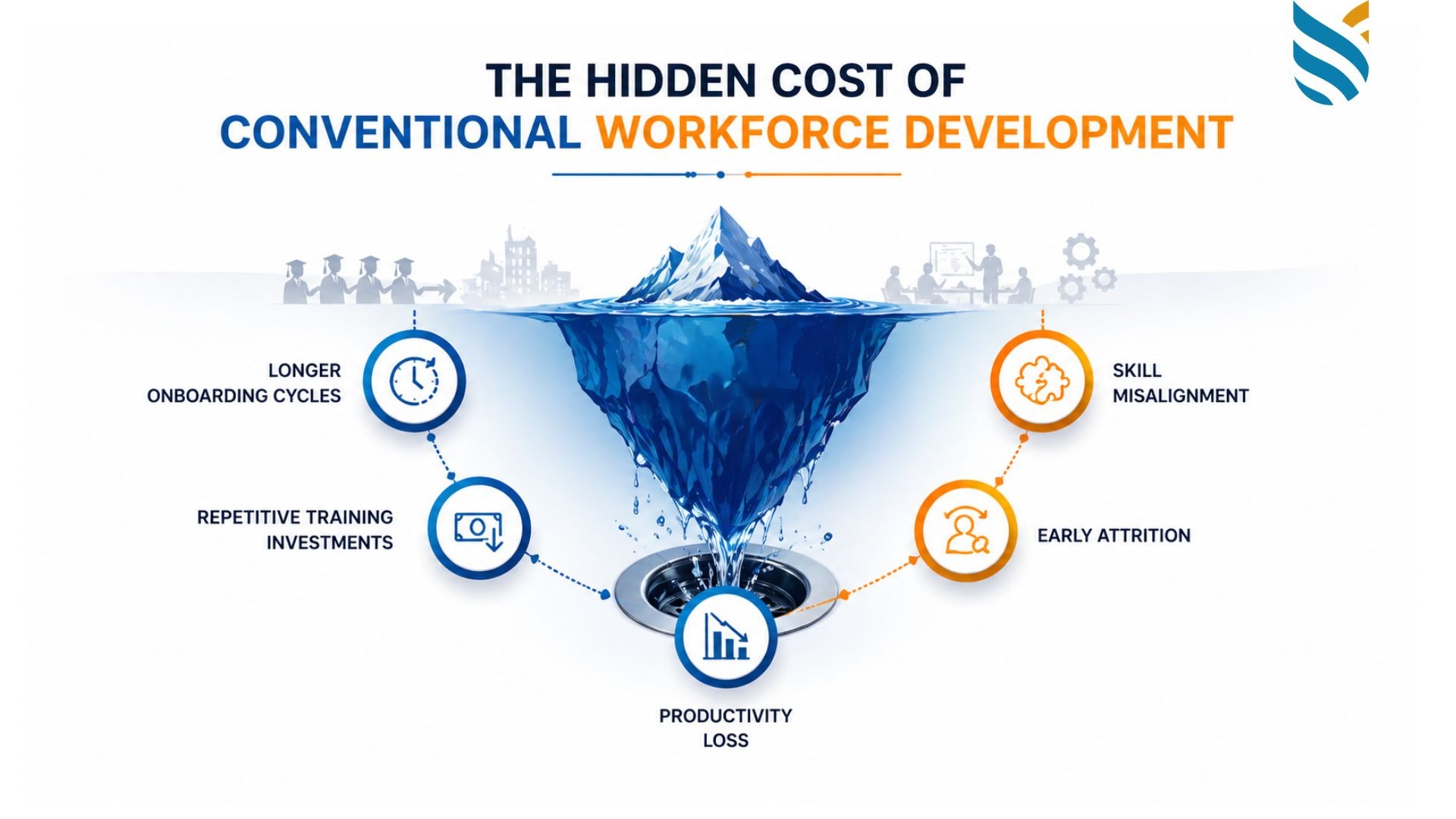
Onboarding cycles stretch before employees reach role readiness. Repetitive training investments follow skill misalignment. Productivity bleeds during classroom-based learning phases. And early attrition - driven by role mismatch and limited career clarity - erases the investment before it compounds. For large and mid-sized enterprises, particularly in sectors with high manpower requirements like manufacturing, healthcare, logistics, hospitality, and retail, these inefficiencies multiply rapidly.
What employers increasingly need is talent that is productive from day one - not talent that requires months of remedial training before contributing meaningfully to the business.
Why Industry-Academia Collaboration Is a Business Imperative
Industry-academia collaboration shifts workforce development upstream. Instead of correcting skill gaps after hiring, enterprises actively shape talent before and during formal education - influencing skill frameworks, embedding real workplace requirements into academic programmes, and ensuring graduates are trained on current tools, processes, and standards.
From a business perspective, this model reduces uncertainty and transforms education into a predictable talent supply chain. Rather than viewing universities solely as talent sources, forward-looking employers are treating them as strategic workforce partners - co-invested in the same outcomes, accountable to the same metrics.
The distinction matters. A placement partnership just produces candidates, whereas an industry-academia collaboration produces capable candidates who are ready to be productive from day
Beyond Placements: What a Real Academic Partnership with Industry Looks Like
Traditional academic engagement often stops at campus placements or short-term internships. These touchpoints have their place, but they rarely create deep alignment between education and enterprise needs. By the time a student completes a placement and enters full-time employment, the gap between what they learned and what the role demands is already baked in.
A genuine academic partnership with industry is built on shared ownership of outcomes - not just shared access to candidates. In practice, this means:
- Curriculum design and periodic updates driven by enterprise input
- On-the-job training frameworks built around real operating environments
- Performance-linked assessments that reflect actual role requirements
- Faculty-industry knowledge exchange, not just CV sharing
- Long-term workforce planning as a shared responsibility
When enterprises participate in shaping how learners are trained, the result is reduced skill variance, faster deployment, and lower training costs - because the learning that happened before hiring was designed around the work, not around the exam.
The WISE Framework: Where This Becomes an Operating Model
Medhavi Skills University's Work Integrated Skill Based Higher Education framework (WISE) provides employers with a structured model to operationalise everything described above. Under this framework, the learners work in live environments to gain practical skills. Their academic credits are earned from the on-the-job learning experience, which is co-designed by enterprises in collaboration with Medhavi Skills University. And the outcomes are calibrated as per the role demands and not just generic academic standards.
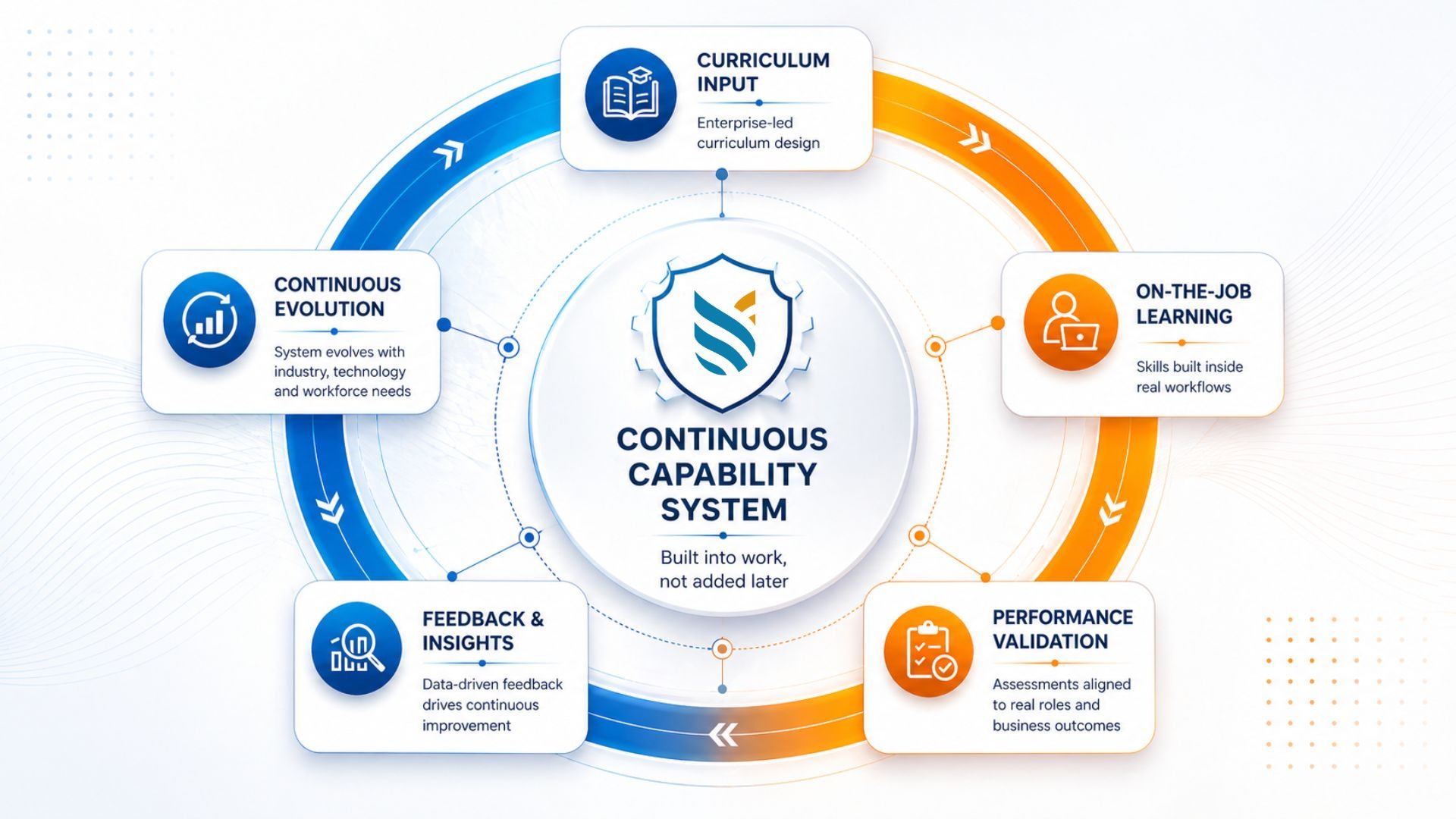
For employers, WISE converts training from a post-hire expense into a pre-integrated capability-building process - one where the enterprise is not waiting for a graduate to arrive job-ready, but participating in making them so.
As a UGC-recognised university and NCVET-aligned awarding body, MSU issues credentials with both academic and vocational weight: degrees, diplomas, and certifications that employees value, families recognise, and resumes feature. When the credential at the end of a learning journey is nationally recognised, the employee's investment in the process changes. Completion becomes meaningful in a way that a platform certificate or internal badge cannot replicate.
Business Impact Across the Talent Lifecycle
The impact of industry-integrated education isn’t limited to one stage—it shows up across the entire talent lifecycle, often in ways that reinforce each other over time.
It begins with enterprises hiring candidates who are evaluated based on what they learned in real work environments, which shortens the training cycle and reduces the upfront training cost.
When enterprises are in a growing stage, hiring job-ready talent helps to create a consistent talent pipeline across branches without depending entirely on fragmented local training efforts. When this model is replicated multiple times, it making it easier to identify high-potential talent and reinforce internal mobility and succession planning for more efficiency.
Strategic Advantages Beyond the Budget Line
The financial case for industry-integrated education is clear. But the strategic case runs deeper.
Enterprises that build genuine academic partnerships with industry become active stakeholders in national skilling priorities - aligning with NEP 2020, supporting employability and inclusive growth, and strengthening ESG narratives in ways that matter to boards and regulators alike. Close engagement with academic institutions also encourages knowledge exchange and applied research, feeding continuous improvement back into workplace practices rather than keeping education and operations in separate silos.
And for employer brand - which is increasingly a talent acquisition strategy in itself - enterprises known for investing in structured learning pathways attract higher-quality candidates and build long-term credibility among the workforce segments they most need to reach.
A Blueprint for Employers Ready to Move
Unlocking the business value of industry-integrated education requires a shift in how enterprises think about their role in talent development - from consumers of output to architects of input.
- Identify critical roles where training costs or attrition are highest - these are the right starting points for industry-academia collaboration.
- Partner with institutions structured for deep industry engagement, not just placement relationships
- Co-create a curriculum aligned with industry needs rather than accepting what already exists.
- Embed structured on-the-job learning and assessment into the model from the beginning.
- Track ROI through metrics that matter to the business - productivity timelines, retention rates, and internal mobility ratios
This approach transforms education from an external dependency into an integrated business function. That shift is available now - the institutions, the frameworks, and the regulatory recognition are in place.
The Bottom Line
In this growing skills-driven economy, fragmented approaches to workforce development will not work in the long run.. The enterprises getting this right are not simply spending less on training. They are spending earlier, with more intention, inside models where education and employment are no longer two separate phases of a person's working life.
Industry-integrated education - built on genuine industry-academia collaboration, a true academic partnership with industry, and a curriculum aligned with industry realities - is the infrastructure that makes that possible. Not as an academic ideal, but as a functioning model where skills are built as capital, credentials create equity, and L&D spend compounds into an economy of skills that the enterprise owns rather than a talent market it perpetually competes in. Medhavi Skills University's Work Integrated Skill Based Higher Education framework - WISE - is that model, built and operational. For the enterprises ready to make that shift, the infrastructure already exists. The only question is how long the current model remains acceptable.