
India stands at a defining inflection point. Graduate employability has fallen to just 42.6%, and nearly half of degree‑holders are considered unemployable, even as the industry reports a 60–73% demand–supply gap in critical tech roles.
The solution is not better hiring.
It is building capability inside the workforce through apprenticeship‑embedded degree models that turn education into a talent creation engine rather than a sorting mechanism.
Why the Current Model Keeps Failing to Close the Skill Gap in India
Despite a large graduate population, enterprises across frontline‑heavy sectors like manufacturing, logistics, healthcare delivery, retail, and large‑scale services continue to see the same pattern year after year:
- Low job readiness in entry‑level and frontline roles
- Rising training and onboarding costs
- Attrition spikes within the first 12–18 months
- Persistent mismatch between curriculum exposure and real operational demands
This gap is structural, not incidental. Over 90% of India’s workforce is in the informal sector and largely outside structured skilling systems, while formal vocational training reaches only about 4% of the population. When skill requirements evolve faster than education models, post‑hire training becomes a permanent correction loop rather than a temporary bridge.
Conventional degree programmes remain largely classroom‑centric and detached from operational environments. As a result, enterprises inherit graduates who require extensive conversion time before contributing meaningfully on the floor. Managers absorb the burden of basic capability‑building. Productivity ramps stretch. Attrition quietly resets training ROI.
For CEOs and CHROs, this is no longer an academic concern. It is an operating risk that compounds every quarter.
The Apprenticeship‑Embedded Degree Model: Building Capability Inside the Workforce
An apprenticeship‑embedded degree integrates formal higher education with structured, paid on‑the‑job training across the full duration of a degree programme. This is not an internship added to a course. It is education redesigned around real work.
Under Work Integrated Skill Based Higher Education (WISE), frontline employees continue in their roles while earning UGC‑ and NCVET‑recognised degrees aligned to the skills their jobs actually demand. Learning outcomes map to live SOPs, tools, compliance needs, and performance benchmarks.
This does three critical things for enterprises:
- Capability is built inside operations, not outside them
- Productivity is maintained while employees upskill
- Learning directly reflects how work is actually performed
For CEOs, this reframes L&D from a recurring cost to a compounding investment.
For CHROs, it transforms workforce development from downstream remediation into upstream capability design.
Why This Matters in a Fast‑Changing Economy
As roles evolve faster than formal job descriptions can keep up, enterprises face a structural risk: the shelf life of skills is shrinking. Employers globally expect 39% of workers’ core skills to change by 2030, with demand for advanced technological skills projected to grow sharply as routine tasks are automated.
Apprenticeship‑embedded degree models create continuous learning loops inside the organisation. Employees develop the ability to adapt as roles change — not through episodic training programmes, but through ongoing skill integration within their job functions.
This reduces long‑term dependence on lateral hiring, which is expensive, unpredictable, and often culturally misaligned. Instead of competing perpetually for “ready talent,” enterprises systematically build role‑ready capability within their own workforce.
In industries where workforce capability directly impacts safety, compliance, quality, and customer experience, this is not a talent initiative. It is operational risk management.
Why CEOs and CHROs Must Move Now
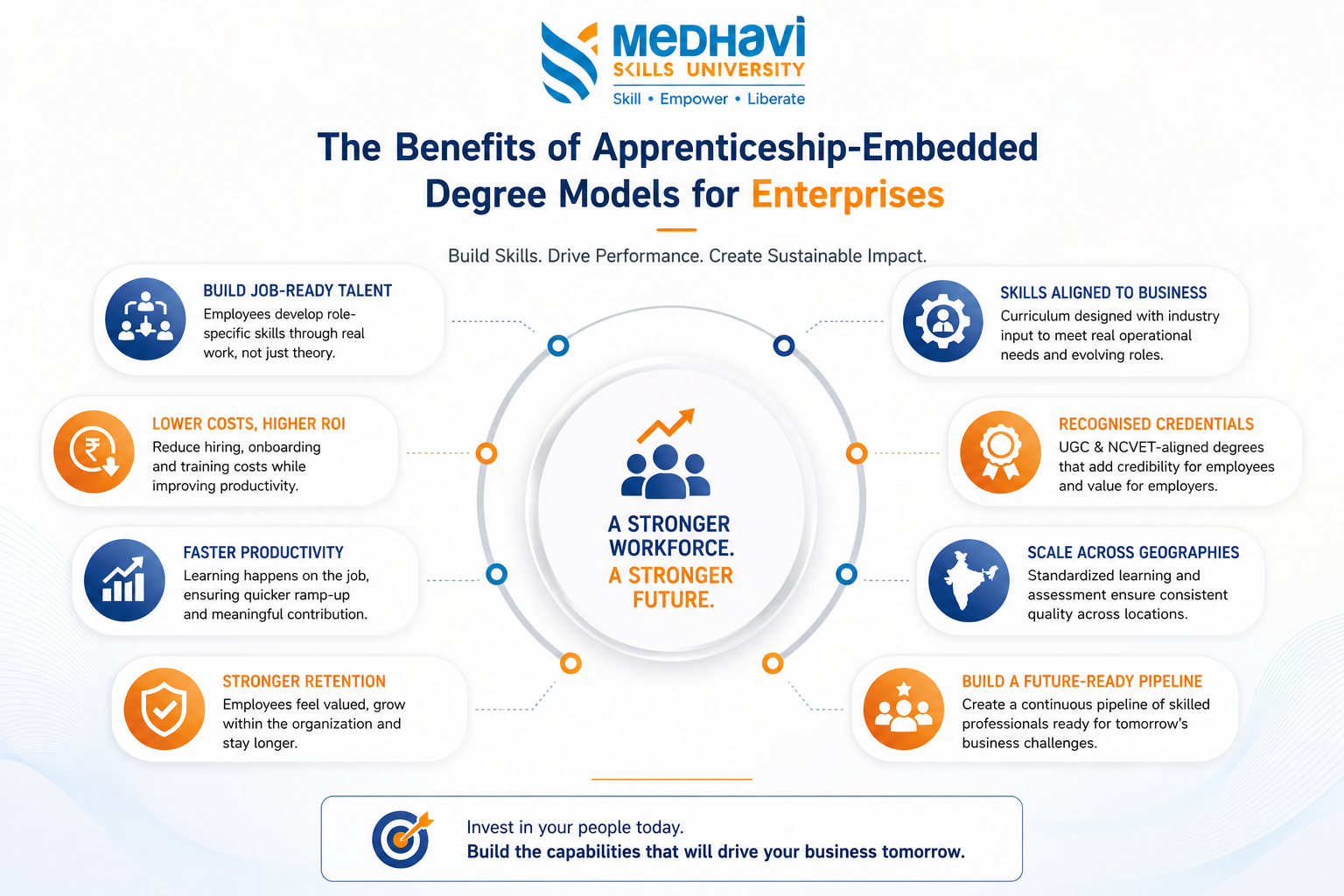
For CEOs focused on sustainable growth and operating leverage, apprenticeship‑embedded degree models deliver structural advantages:
- Lower talent acquisition pressure through internal pipelines
- Faster productivity because ramp‑up happens during learning
- Stronger workforce stability through early organisational embedding
- Higher ROI on human capital because capability is co‑created, not corrected
For CHROs, the shift is strategic:
- Learning outcomes align directly with live job roles
- Talent pipelines become predictable across critical functions
- Succession planning strengthens for frontline and supervisory layers
- Employer brand is built around career‑building, not hiring volume
Most importantly, HR moves from reactive hiring to proactive workforce architecture — where capability is designed in advance, not chased after the fact.
Why India Is Uniquely Positioned for This Shift — And How MSU Enables It
India’s National Education Policy 2020 explicitly supports work‑integrated learning, industry participation in curriculum design, and skill‑based higher education. This creates rare structural alignment between national policy and enterprise workforce needs.
Despite its demographic scale, India currently has only about 2.3 lakh trade apprentices in training across roughly 30,000 establishments, against policy targets in the 10–20 lakh range — evidence of how under‑leveraged apprenticeship remains as a workforce strategy.
Medhavi Skills University was purpose‑built for this convergence. As a UGC‑recognised university and NCVET‑aligned awarding body, MSU enables enterprises to embed apprenticeships within degree pathways through its Work Integrated Skill Based Higher Education (WISE) framework.
For enterprises, this means:
- Frontline employees upskill without leaving the floor
- Credentials carry institutional recognition, not just platform value
- Curriculum reflects actual operating conditions
- Workforce capability scales consistently across geographies
This is not a pilot that works in one location. It is infrastructure designed to deliver uniform skill standards whether operations run in Chennai, Pune, or Guwahati. Credentials earned are degrees families recognise and resumes feature. And L&D spend compounds into an internal skill economy instead of leaking into the external talent market.
From Hiring Talent to Architecting Talent
Closing the skill gap in India requires a shift in how enterprises relate to education itself — from consuming graduates to co‑creating capability.
Apprenticeship‑embedded degree models enable that shift. Learning and working happen simultaneously. Credentials carry institutional weight. Capability is shaped before performance risk appears.
For CEOs and CHROs, adopting apprenticeship programmes is no longer an experiment. It is a leadership decision about how the organisation will secure skills for the next decade of growth.
The infrastructure exists. The only open question is how long the current model remains acceptable.