
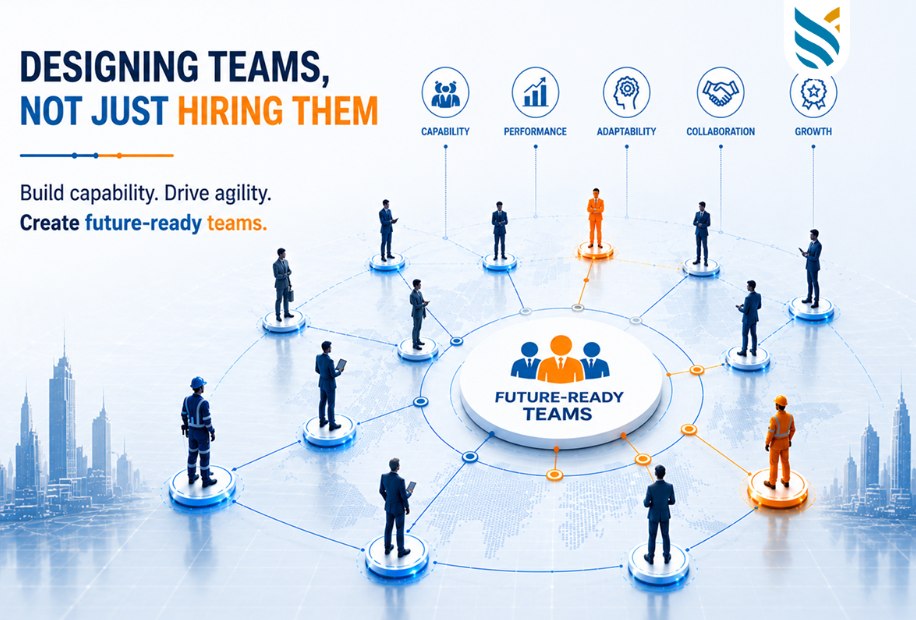
The modern Chief Human Resources Officer (CHRO) has transitioned from a back-office administrator to a strategic architect of human capital, directly driving business growth and enterprise resilience.
However, enterprises are struggling to find candidates who are not just qualified for hire but also job-ready in the workplace. Especially in frontline and operational roles across volatile industries such as retail, logistics, manufacturing, BFSI operations, hospitality, healthcare delivery, and large-scale services, this gap is impacting the ROI.
Since skills are upgrading with AI adoption, finding efficient and job-ready talent is getting difficult. Moreover, the costs of lateral hiring and reskilling continue to rise. Compensation alone cannot keep employees engaged; CHROs need to create career pathways to retain the new hires.
The issue is not that enterprises lack hiring capacity. They are being asked to build teams, not just staff them. The traditional model of hire-then-train no longer produces the capability, agility, or loyalty that competitive enterprises require.
The solution lies in a more integrated approach—work-integrated degree programmes.
What “Future-Ready Teams” Look Like on the Ground
Before discussing how to build future-ready teams, it helps to define what they actually look like in operational terms. You stop managing a group of people doing isolated tasks and start leading a "Future-Ready" team. This isn't a vague HR concept—it’s a visible change in how work gets done.
Breaking the "Pigeonhole" with Functional Mobility
In a typical factory or warehouse, workers are often stuck in one spot. If a specific line goes down or a different department gets slammed with orders, those workers usually sit idle because they aren't trained to help anywhere else.
A future-ready team solves this through seamless mobility. Because their education is broad and recognised, these employees can move between functions as the business demands. They don't have to start from scratch every time they move because they already understand the company’s broader ecosystem. They become versatile assets who keep production moving, rather than static fillers on a single line.
Proving "Learnability" in Real-Time
The biggest risk to any operation today is a team that can’t adapt to new tech or software. Employee upskilling is essentially a test of mental agility. Workers who balance a degree programme with a full-time shift have already proven they can learn on the fly.
This "learnability" means they can pick up new machinery or digital workflows and integrate them into their daily routine almost immediately. You no longer face a three-month ramp-up period every time you upgrade your equipment; your team has the foundation to stay ahead of the curve.
Building Bench Strength and Internal Pipelines
A resilient enterprise doesn't scramble when a supervisor retires or moves on. They have "bench strength"—a reservoir of people who are already credentialed and ready to step up. By building a pipeline of promotion-ready talent, you stop being dependent on a volatile external job market.
This is where workforce development pays for itself. You aren't just hiring for a shift today; you are cultivating the managers you’ll need three years from now. This kind of internal mobility isn't just a metric—it’s a massive cost-saving strategy that keeps your institutional knowledge inside the building.
Collaboration Without the Usual Friction
Friction happens when people don't understand how their role impacts the next department. A degree-earning worker on the frontline sees the bigger picture. They learn about logistics, quality control, and safety protocols as part of their curriculum.
This gives them a cross-functional capability that is rare in traditional setups. They can talk to engineers, warehouse managers, and safety officers in the same language. When everyone understands the "why" behind the workflow, the friction between departments disappears.
Ownership That Drives the Bottom Line
These aren't abstract ideas; they show up in your data. Better-trained teams have lower error rates, fewer safety incidents, and higher Overall Equipment Effectiveness (OEE).
When an employee sees that their performance on the floor is directly linked to their academic success, they stop "putting in time" and start building a career. They take ownership of their station because they see it as part of their personal growth.
This shift turns corporate training programmes from a series of disjointed events into a permanent capability infrastructure. It ensures that as your company scales, the people running it are growing at the exact same pace.
Why Degrees Inside the Workplace Change the Talent Equation
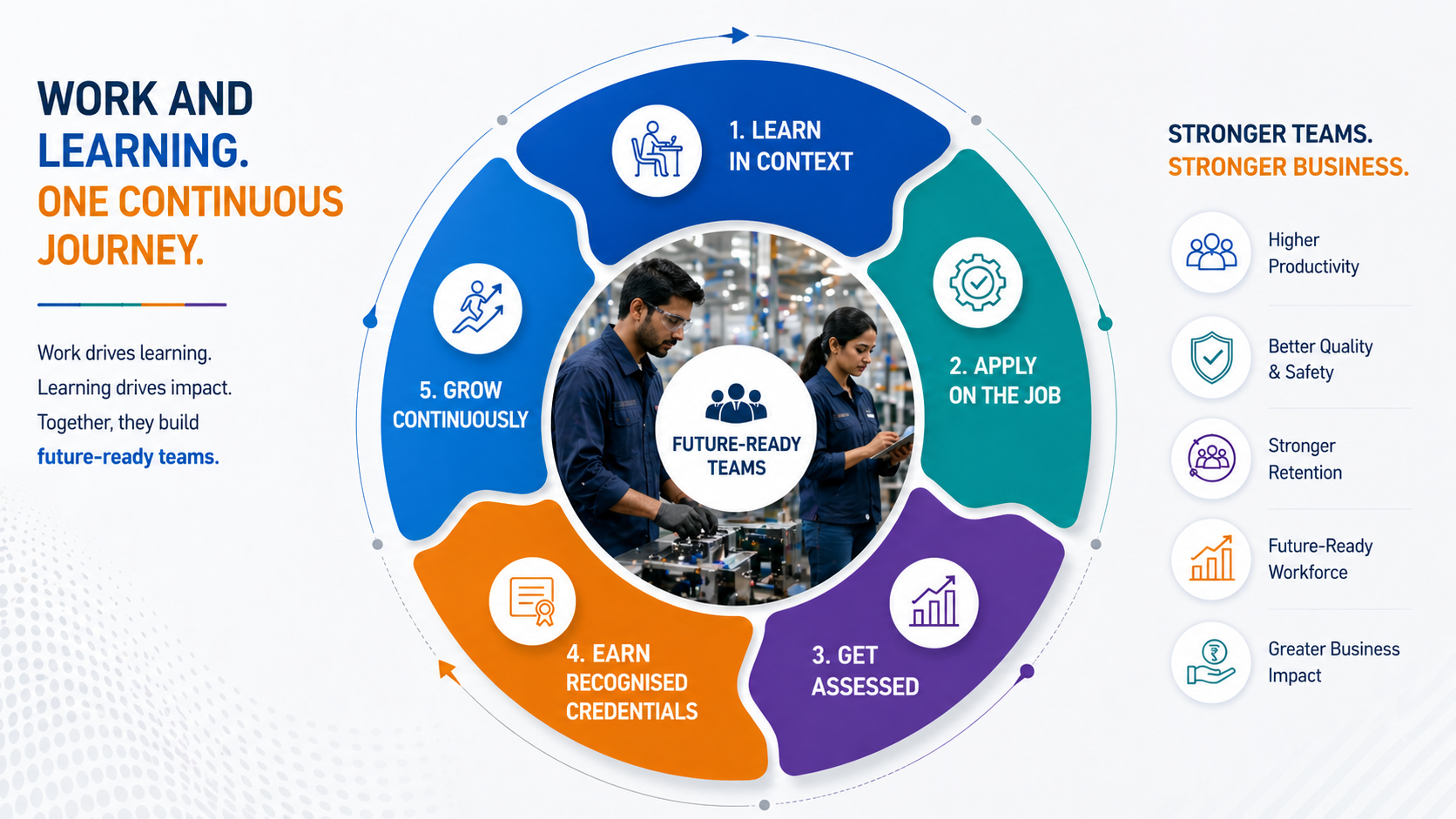
Work Integrated Skill Based Higher Education allows enterprises to upgrade the capability of their existing workforce without pulling employees out of operations. Frontline employees perform their actual functions while advancing their careers with UGC and NCVET-recognised degrees aligned to their actual job functions. Simply, what they learn is driven by practical exposure rather than theory and their assessment is linked to workplace performance.
This is not training with academic language layered on top. It is education redesigned around work. The classroom and the workplace become a single, continuous talent-building system.
India’s National Education Policy 2020 prioritises flexible, work-integrated education models. Enterprises adopting UGC and NCVET-recognised work-integrated degrees align not just with workforce needs, but with national skilling priorities that increasingly shape employer brand and talent trust.
For CHROs, this model changes the talent equation in three fundamental ways.
First, it shifts investment upstream.
Enterprises stop spending disproportionately on post-hire correction, such as extended onboarding, repeated retraining cycles, and external reskilling vendors. Instead, they invest in building capability inside ongoing employment, without taking people off the floor. The corporate learning and development spend does not reset with every cohort. It compounds.
Second, it creates credential pathways as retention infrastructure.
Employees work toward a recognised degree while contributing to the business. Every credit earned becomes equity in the relationship. Retention is no longer driven primarily by incremental salary adjustments or retention bonuses. It is built into the structure of how people grow inside the enterprise.
Third, it aligns learning with workforce strategy.
Rather than treating education, training, and workforce planning as separate functions, Work Integrated Skill Based Higher Education (WISE) unifies them under one framework. Learning outcomes, business outcomes, and career pathways are designed together from the start.
A Practical CHRO Playbook: How to Operationalise This Model
For CHROs considering implementation, success depends on strategic design rather than experimentation.
Step 1: Identify Critical Roles and Skill Clusters
Start with roles where training costs are highest, attrition is most damaging, or skill shortages are most acute. In most enterprises, these are frontline and operational roles where pulling employees out for training directly impacts productivity. Map competencies not only for today’s version of the role, but for how the role is evolving.
Step 2: Select Academic Partners with Industry-Aligned Capabilities
Look for institutions that can co-create curriculum, operate flexibly within UGC and NCVET frameworks, and run work-integrated learning at enterprise scale. The partnership should be built on shared workforce outcomes, not just access to credentials.
Step 3: Co-Create Curricula Mapped to Real Work
Design learning pathways that reflect actual workflows, tools, and performance expectations. This is not about guest lectures. It is about ensuring that what is taught and credentialed is directly usable in the roles employees perform daily.
Step 4: Integrate Learning into Performance and Progression
Make learning milestones visible in performance reviews, role progression, and internal mobility pathways. When development is tied to career movement, employees engage more deeply.
Step 5: Establish Measurement Frameworks
Track time-to-productivity in upgraded roles, retention among participants, internal mobility velocity, skill readiness, and manager feedback. These are the metrics that connect learning investment to business value.
What Changes for the Enterprise
The impact of Work Integrated Skill Based Higher Education (WISE) compounds across the talent lifecycle.
- Retention improves structurally, not incrementally, as employees build their professional identity inside the enterprise while earning credentials with institutional weight.
- Internal mobility accelerates when capability becomes visible through performance in real environments, not just assessments.
- Ramp-up time compresses for advanced roles as employees are already familiar with tools, workflows, and expectations.
- Bench strength develops organically since succession pipelines are built from within, reducing dependency on lateral hiring.
- Workforce planning becomes measurable with cohort progression, skill readiness, and deployment timelines that get tracked with the same rigour as headcount.
For CHROs, this becomes one of the most durable employee retention strategies available. Employees do not leave enterprises that are structurally invested in their long-term growth. They leave when growth stalls or pathways disappear. Work Integrated Skill Based Higher Education (WISE), anchored in recognised credentials, makes growth visible, credible, and continuous.
The MSU WISE Model: From Programmes to Workforce Infrastructure
At Medhavi Skills University, we have built our institution specifically to operationalise Work Integrated Skill Based Higher Education (WISE) at enterprise scale. We are a UGC-recognised university and an NCVET-aligned awarding body, positioned at the intersection of academic rigour and industry outcomes.
MSU’s WISE framework is designed for working professionals in frontline and operational roles. We design curriculum in collaboration with the enterprises for the specific job roles, while the employee can work on the floor, embedding learning into workflows, and building credential-backed talent pipelines that scale across geographies.
It is the co-creation of workforce capability. Learning happens inside real operations. Assessment is linked to performance. Credentials earned carry institutional weight.
Because the credentials are nationally recognised, corporate learning and development spend does not reset with each cohort. It compounds into an economy of skills the enterprise builds internally, rather than a talent market it must constantly compete in.
The Bottom Line: From Hiring Teams to Designing Teams
Building future-ready teams is no longer optional. It is a strategic choice that shapes enterprise resilience in the future of work.
The shift is clear. Move from hiring finished talent to designing talent pathways. Move from managing headcount to building capability. Move from treating education as external to embedding it as workforce infrastructure.
Work Integrated Skill Based Higher Education (WISE) makes this shift possible. It allows enterprises to upgrade frontline capability without productivity loss, anchor retention in recognised credentials, and build internal talent pipelines that scale with business growth.
In India’s fast-changing economy, the frameworks and partnerships to do this already exist. The question for CHROs is no longer whether this model works. It is how long the cycle of hire, retrain, attrit, and repeat remains acceptable when a more durable workforce system is within reach.