Microbiology Specialist University in Sikkim: Course Overview and Scope
Microbiology is extremely significant in modern health care since it allows the professionals to understand microorganisms, diseases, laboratory diagnosis and infection control. Students looking for Microbiology Specialist University in Sikkim can definitely consider Medhavi Skills University as an option. Choosing the right skills-based and industry-oriented programme will provide them with both theoretical and practical knowledge needed to thrive in the real world of microbiology.
Clinical microbiology is a branch of microbiology which concerns only those microorganisms that pertain to human health and disease. The students will obtain skills of identification and studying of microorganisms in the laboratory, the process of how lab tests help make a diagnosis and how microbiology helps with patient care. As medicine, diagnostic laboratories and research are becoming more and more advanced, there is a constant need for highly qualified specialists in the sphere of microbiology.
How to Choose the Right University for Microbiology in Sikkim
The university that the students select plays an important role because it has a direct bearing on the quality of education they receive. Thus, when thinking of becoming clinical microbiology specialists, students should consider not only the name of the programme but the atmosphere in which it is carried out, the effective curriculum, training, etc.
There are many things to look for that may help in one’s paramedical career, here are some of the factors:
- Hands-on lab skills: Microbiology requires good laboratory skills, especially in dealing with samples and performing tests.
- Exposure to real-world situations: Experiences in healthcare industries like hospitals, clinics, diagnostic centers, etc. can help students apply their theoretical knowledge to real-world scenarios.
- Relevant curriculum: Look for programmes with a comprehensive curriculum covering bacteriology, virology, immunology, diagnostic microbiology and lab management.
- Possibility for research: Projects and dissertation works can improve analytical and research skills.
- Faculty expertise: Experienced academicians and practitioners can provide valuable theoretical knowledge and practical skills.
- Career opportunities: Placement assistance, internships, student cooperations, industry interaction and connections with real-world professionals can help students with their career transition.
For those students exploring paramedical education and career in Sikkim, it is important to find a university that focuses on practical skills instead of just theoretical knowledge. Choosing a skills-based university like Medhavi Skills University could be particularly beneficial in this aspect.
Eligibility for Clinical Microbiology Programmes
Eligibility criteria differ across various colleges and programmes. However, it is a still fact that these clinical microbiology programmes are generally meant for persons having a life sciences background.
As per the Medhavi Skills University, having graduated in the courses like Biotechnology, Zoology, Botany, or Microbiology makes the candidate eligible for M.Sc. in Clinical Microbiology. This is a postgraduate programme of two years duration which aims at imparting advanced theoretical and practical knowledge related to clinical microbiology.
Students are advised to make sure about the current eligibility criteria prevailing at the time of admission, as the same can change each year.
Admission Process for Microbiology Programmes in Sikkim
The process of admission may vary in different universities, but it is usually mostly similar and straightforward.
The application procedure at the Medhavi Skills University is as follows:
- Apply for MSAT, 2026: Fill the online application form and pay the ₹1,000 application fee.
- Take MSAT, 2026: Complete the home-based online aptitude test.
- Check Results: Receive the MSAT score, scholarship eligibility and admission offer letter.
- Provisional Admission: Pay the one-time admission fee and receive the provisional admission letter.
- Final Admission: Complete document verification and pay the semester fee.
The MSU website provides up-to-date information for candidates requiring information regarding admission procedures.
M.Sc. in Clinical Microbiology at Medhavi Skills University
The two-year M.Sc. in Clinical Microbiology offered by the School of Health Science & Technology at Medhavi Skills University provides specialised postgraduate training for its students.
The programme has an effective curriculum that combines theoretical studies with practical application. The main areas of curriculum include the following subjects:
- Core Clinical Microbiology
- Immunology and Virology
- Diagnostic and Applied Microbiology
- Laboratory Techniques and Management
- Clinical Exposure
- Research and Dissertation
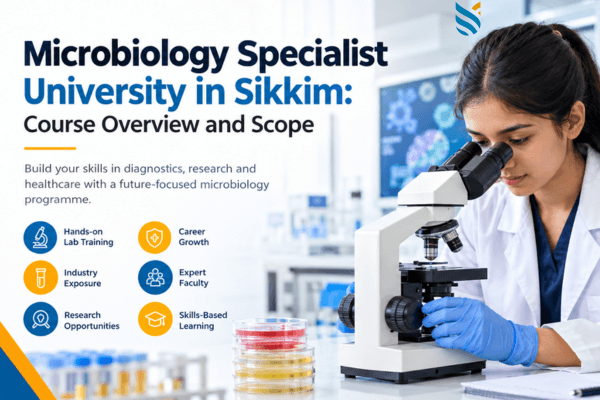
The implementation of the practical module of the programme is aligned with industry requirements as at least 70% of the curriculum consists of practical elements and there are opportunities for up to six months of paid On-the-Job Learning (OJL). The students are also provided with practical experience in lab environments, as well as the opportunities to visit numerous laboratories and get to know about the profession.
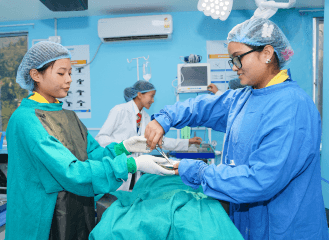
The process of training is enhanced with the use of advanced medical microbiology laboratories and technical equipment, which helps students understand the diagnostic procedures and issues. For students, who are interested in related fields, programmes in medical laboratory science, dialysis therapy, medical radiology and imaging technology, anaesthesia and operation theatre technology are also offered by MSU.
Skills Developed During a Clinical Microbiology Programme
An advanced postgraduate programme should allow students to gain fundamental knowledge of science and laboratory skills, both practical and theoretical skills. The prominent areas are as follows:
Laboratory & Diagnostic Skills
Students become aware of laboratory techniques, identification of microorganisms, methods of diagnosis and handling of samples.
Analytical and Research Skills
Clinical microbiology deals with the meaning of test results and testing techniques. Research work and thesis writing make it possible to either develop analytical thinking or improve skills of interpreting data.
Infection Control Knowledge
Knowledge of infectious organisms and their propagation provides students with crucial information about infection control, biosafety and laboratory safety.
Laboratory Management
Modern laboratories need qualified specialists who possess knowledge of quality control methods and documentation.
The above-mentioned skills can be beneficial for specialists pursuing medical laboratory technician career scope, clinical diagnostics and research-oriented roles.
Career Opportunities After Clinical Microbiology
An advanced qualification in clinical microbiology can create opportunities across the healthcare sector, ranging from diagnostics to research and other related scientific fields.
Possible career options include:
- Clinical microbiologist
- Laboratory technologist
- Research associate
- Quality assurance analyst
- Clinical microbiology laboratory technician
- Clinical research associate
- Quality control and safety officer in laboratory
Graduates can become employed in different types of institutions including hospitals, diagnostic labs, research institutes, pharmaceutical companies and other healthcare facilities.
Students willing to pursue careers in laboratory-related occupations can also consider other routes of study. MSU has training options in the areas of medical laboratory sciences for students at the diploma, bachelor’s and postgraduate level, therefore, opening up opportunities for learners to study in the field of laboratory sciences.
Future Scope of Microbiology in Healthcare and Research
With the advances in diagnostic medicine, molecular diagnosis, research into infections and the introduction of more innovative technologies, the importance of microbiology continues to grow.
The field might also be relevant in areas other than diagnostic laboratory including:
Biomedical and clinical research
Biopharmaceutical industry
Infection prevention
Molecular diagnostics
Quality and laboratory management
Public health
Academic and research institutions
If you are interested in applying for a scientific career connected with healthcare, consider pursuing a career in clinical microbiology, which combines laboratory science, diagnostics and research.