
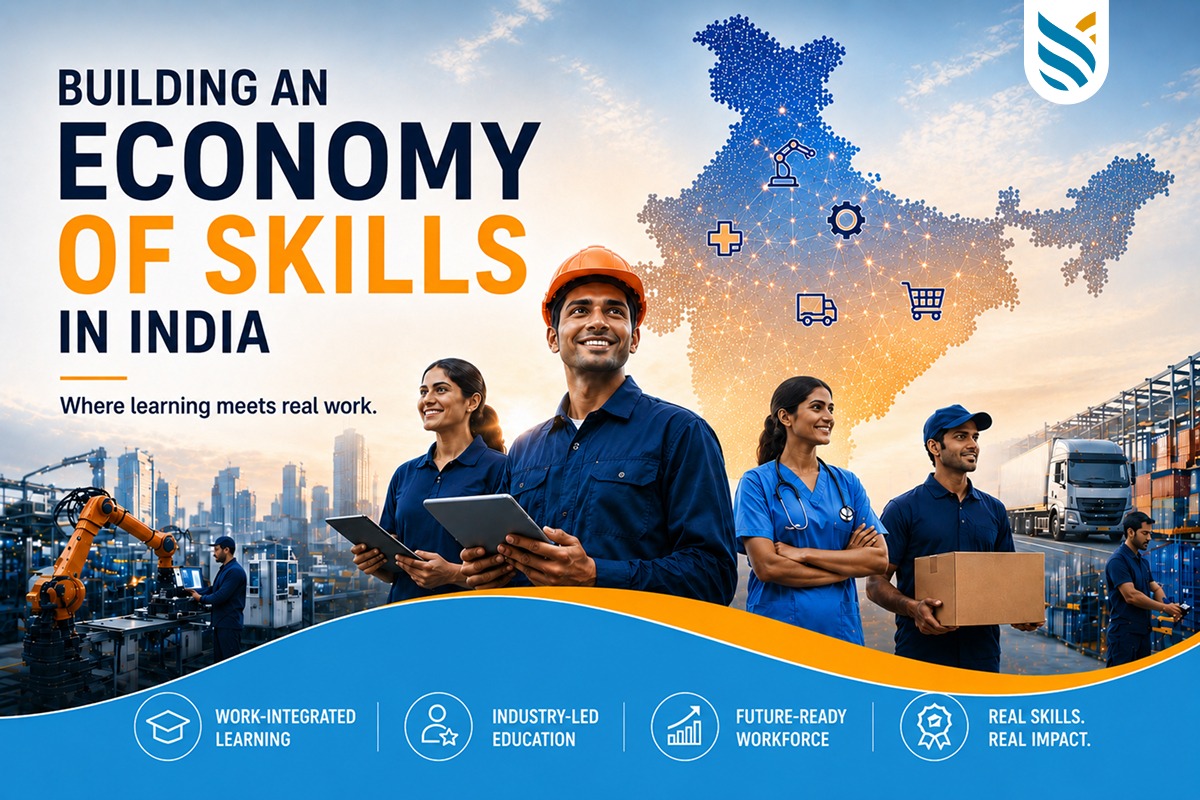
Building an Economy of Skills: Why Work-Integrated Education Is Shaping India’s Workforce
India is still preparing many people for roles that no longer reflect how work is actually done today. It is an uncomfortable truth — one that points to a deeper challenge in how we build capability inside the workforce.
As technology reshapes industries and frontline roles in manufacturing, logistics, healthcare delivery, retail, and large-scale services demand adaptability, problem-solving, and digital confidence, much of learning still follows models designed for a different era — when repetition mattered more than relevance. For workforce development to remain effective at scale, practical learning must move closer to the centre of education, supported by theory rather than separated from it.
This is why Work Integrated Skill Based Higher Education (WISE) is emerging not as a trend, but as a structural correction. WISE does not treat learning and working as separate phases. It brings them together — allowing industry to actively shape learning and the workplace to become part of the education environment itself.
The Problem We Don’t Want to Admit
India does not suffer from a lack of degrees.
It suffers from a gap between what people are taught and what work actually demands.
The India Skills Report 2026 makes a critical observation: employability today depends on pathways that connect learning to earning. Yet for much of India’s workforce — especially in frontline-intensive sectors like manufacturing, logistics, healthcare delivery, retail, and large-scale services — learning and earning remain disconnected phases of life.
Every year, organisations onboard capable employees who hold formal qualifications. Yet the first few months are often spent unlearning habits, rebuilding basics, and closing gaps that education was supposed to bridge. This is not because people lack ability; it is because their learning journey rarely mirrored real operating conditions.
For employees, this gap shows up as uncertainty. They know concepts, but not how performance is measured on the floor.
For organisations, the cost is persistent but quiet — extended onboarding cycles, inconsistent early performance, and managers teaching fundamentals instead of building teams.
In a skills-led economy, this mismatch weakens the entire talent pipeline. Degrees alone no longer signal readiness. Work-readiness has to be built inside the workplace, not assumed at the point of hiring.
Why Traditional Education Struggles to Keep Pace with Work
Education systems were built for stability. Workplaces now operate in constant change.
This shift is already visible in how professionals themselves think about value in the labour market. Across industries, people no longer assume that a degree alone will carry their career forward. What is gaining weight instead is demonstrable skill, the ability to stay relevant as roles evolve, and access to continuous upskilling inside the workplace.
In practice, this means credentials on their own are no longer seen as proof of readiness. What matters more is whether someone can perform in live environments, adapt as tools and processes change, and keep building capability over time. In a skills-led economy, capability now ages faster than credentials.
WISE responds to this reality by shifting the centre of learning from static content to applied capability — from coverage of syllabus to development of skill that holds up under operational pressure.
How Work-Integrated Learning Builds Future-Ready Workforce Skills
Research on Work-Integrated Learning (WIL) consistently shows that learners who develop skills inside real work environments demonstrate:
- Higher employability
- Better alignment between education and job roles
- Stronger communication, problem-solving, teamwork, and professional readiness
- Improved job acquisition outcomes compared to classroom-only pathways
This matters because these are precisely the skills enterprises struggle to build through post-hire training.
Work Integrated Skill Based Higher Education (WISE) brings this evidence into enterprise workforce design — especially for existing frontline employees who continue working while earning recognised credentials. Capability is built through repeated application inside real workflows, not simulated scenarios. This is why WISE delivers what traditional education promises but rarely achieves: actual readiness.
Why WISE Works for Today’s Workforce
The shift toward learning inside work is already happening in Indian enterprises. Studies on corporate learning and development show that:
- On-the-job learning is expanding as a preferred development model
- Organisations with strong learning cultures show higher retention, stronger internal mobility, and healthier leadership pipelines
This signals organisational readiness for models like WISE that embed learning into operations rather than layering training on top of work.
For frontline-heavy industries — manufacturing, logistics, healthcare services, retail operations, hospitality, and industrial services — this is particularly powerful. Capability directly affects safety, quality, compliance, and customer experience.
When WISE is implemented well:
- Employees learn in live environments
- Corporate learning and development aligns directly with operational reality
- Transition friction reduces
- Adaptability becomes habitual, not theoretical
A Workforce Strategy, Not a Program: The MSU WISE Model
What we have described so far is not just a philosophy. At Medhavi Skills University, it is workforce infrastructure.
The MSU WISE model enables enterprises to upskill existing frontline employees while they continue working, earning UGC-recognised and NCVET-aligned credentials in parallel. Productivity is not paused. Learning is embedded into operations. Capability compounds inside the business.
This model works because Indian enterprises are already increasing L&D effort and shifting learning closer to work. WISE provides the structural framework to make that shift durable, credential-backed, and scalable across locations.
What enterprises gain:
- Custom-trained internal pipelines aligned to real roles
- Reduced post-hire training burden
- Lower early attrition through visible career pathways
- Faster readiness for supervisory and technical progression
- Employer positioning as a career-building organisation, not just a payroll
At scale, WISE moves corporate learning and development from a cost centre to workforce infrastructure.
A Future Built on Work-Integrated Learning
India’s demographic scale will only become a competitive advantage when learning systems evolve alongside how work is actually organised on the ground.
By embedding education into live operating environments and anchoring it in nationally recognised credentials, MSU’s WISE approach enables enterprises to grow capability from within — while enabling frontline employees to earn degrees without stepping away from work.
This is how India moves from a workforce of degree-holders to an economy of skills.
And for organisations that choose to build rather than just hire, it is how durable capability is created.