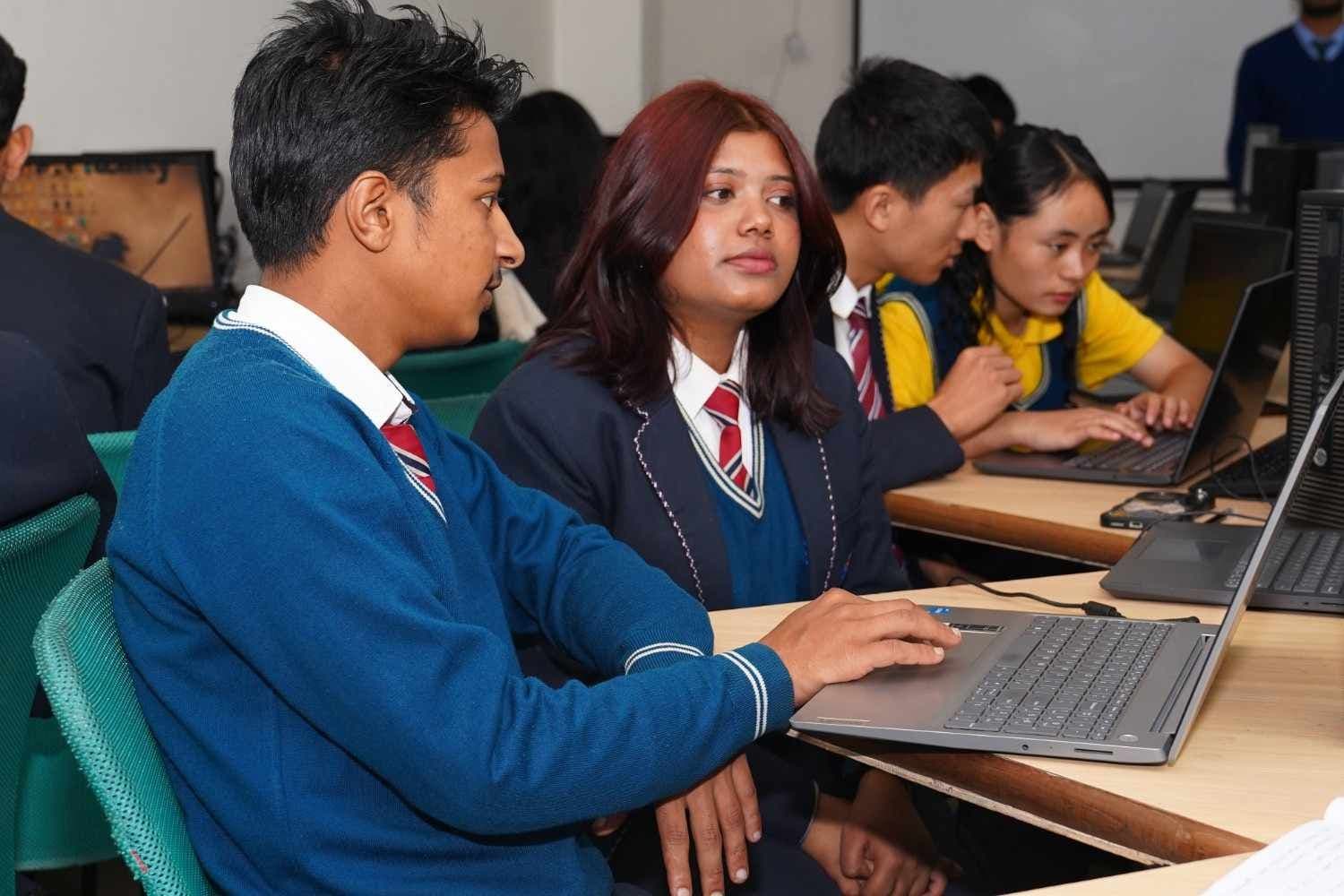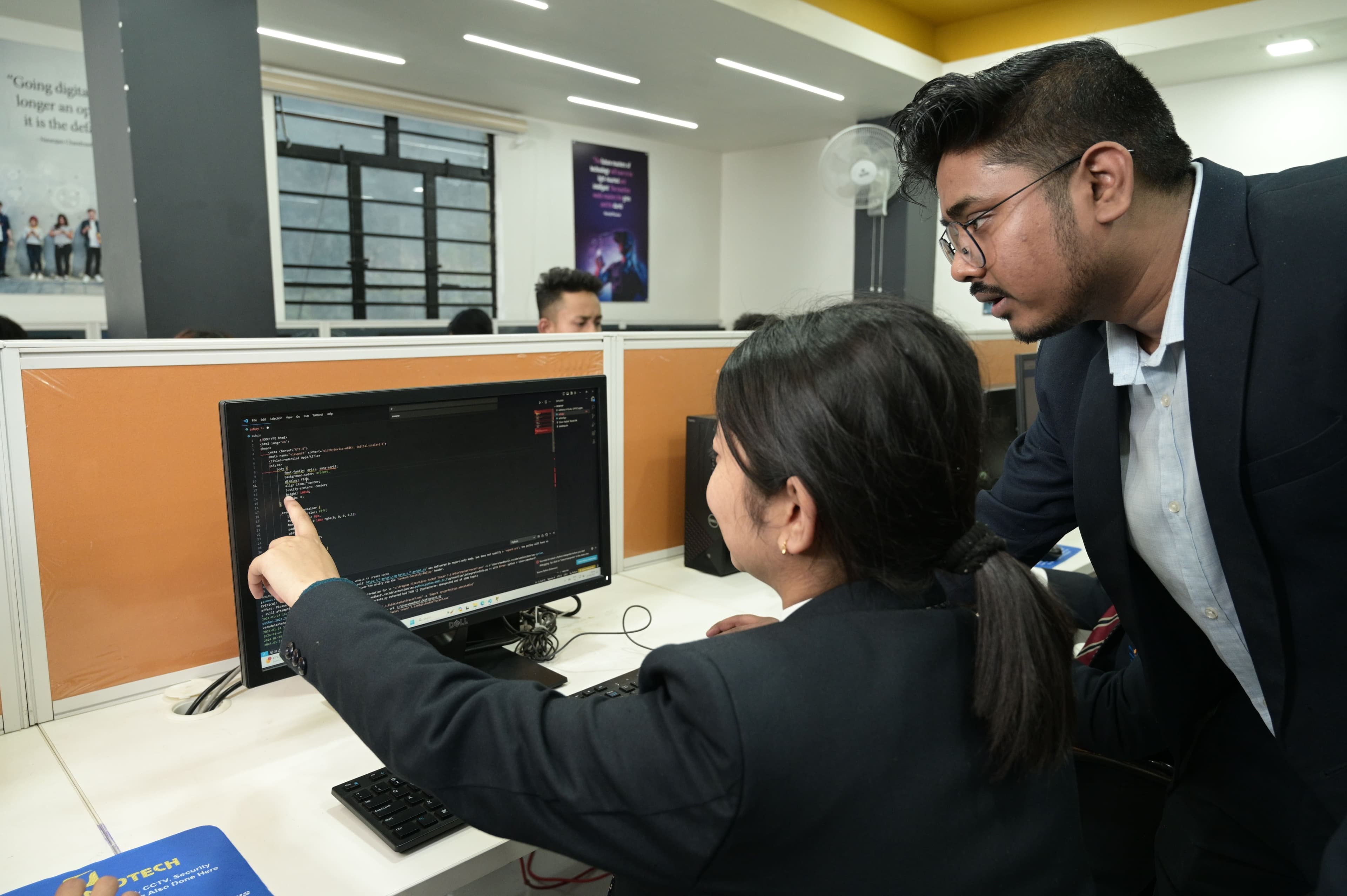
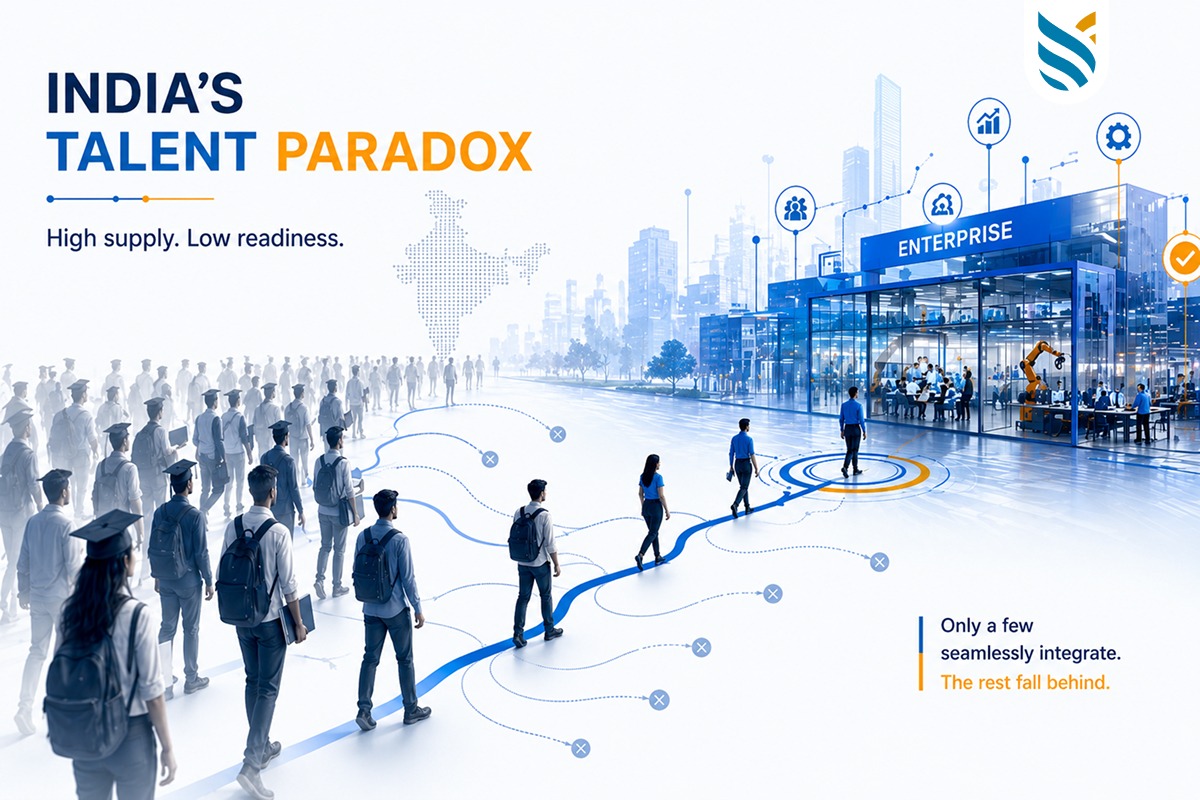
India is home to one of the world’s largest youth populations, yet enterprises across sectors are struggling to find job-ready talent. The paradox highlights a critical issue: the skill gap in India.
While millions graduate every year, employers report that a significant percentage of new hires lack real skills, industry experience, and workplace readiness.
The pressure is highly visible, especially in the frontline and operational divisions across manufacturing, logistics, healthcare delivery, hospitality, retail, BFSI operations, and large-scale service environments, where productivity depends on staff performing well from the first day on the floor.
Enterprises feel the gap quietly but continuously. New hires need extended onboarding, and managers spend months correcting basics instead of building teams that result in slow productivity and early attrition. This often goes unobserved, but the business absorbs the cost in the form of quality gaps, work delays, and stress on existing teams.
This is where work-integrated learning emerges as a transformative solution. Medhavi’s initiative, Work Integrated Skill-Based Higher Education (WISE), is a strategic offering for a future-ready workforce that turns talent development from a recurring cost into a long-term capability asset.
Understanding the Skill Gap in India from a Business Perspective
The skill gap in India is the dissimilarity between what students learn while studying and what employers need in the actual workplace.
Why Does This Gap Exist?
- Academic systems remain heavily theory-driven, with minimal focus on application.
- There is insufficient integration between education and industry exposure.
- No skills development due to a lack of structured hands-on training.
- A stagnant curriculum leads to technological disruption.
As a result, new hires demand extensive retraining before becoming productive, and workplace readiness remains inconsistent. Also, it leads to high early-stage attrition driven by role mismatch and unmet expectations.
For enterprises, it translates into higher hiring costs, prolonged onboarding cycles, productivity loss, and pressure on experienced employees to compensate for gaps that should never have arrived in the first place. In frontline-heavy industries, it directly impacts safety, service quality, compliance, and customer experience.
Why Traditional Hiring Models Are No Longer Sustainable
Historically, organisations hired based on degrees and then relied on corporate learning and development teams to close the gap. In stable environments, it worked reasonably well. In fast-changing operating contexts, it does not.
The frustration is that the cycle is well known. The graduate joins underprepared. The organisation have to train till the employee gets productive. While it takes time, the employee feels misaligned and leaves for a better opportunity. The organisation is stuck in a repeating cycle with the next cohort.
As roles evolve faster, tools change more frequently, and processes digitise rapidly, post-hire training alone cannot keep pace. Enterprises are discovering that by the time employees are “ready,” job requirements have already shifted.
This is why leading organisations are moving from correcting capability after hiring to building capability inside ongoing employment, without removing employees from the floor.
The Shift: Building Workforce Capability Where Work Actually Happens
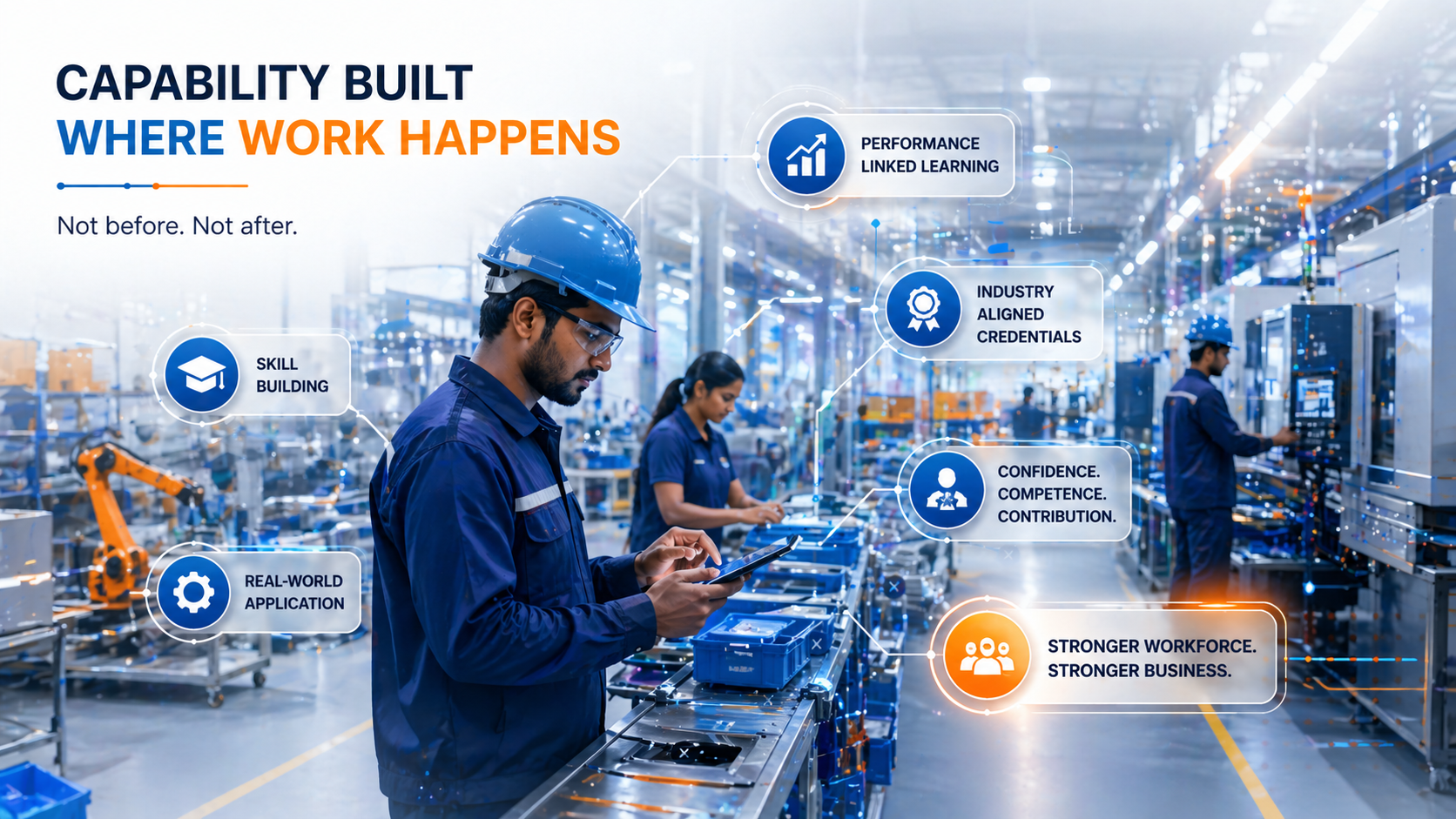
Work Integrated Skill-Based Higher Education (WISE) starts from a different premise: the separation between learning and working is not natural; it is a design flaw.
WISE enables enterprises to upskill their existing frontline and operational employees while they continue working. Learning is embedded in real operating environments. Assessment is linked to performance. Credentials earned are UGC and NCVET-recognised degrees and certifications aligned to actual job roles.
It is not classroom learning with workplace examples added later. It is education structured around how work is done inside factories, warehouses, service centres, hospitals, hospitality operations, and customer-facing environments.
For enterprises, this approach changes workforce development from a downstream HR activity into upstream workforce infrastructure.
Addressing the Skill Gap from the Root
Every enterprise that runs repeated onboarding cycles understands the cost: time, money, managerial bandwidth, and early attrition. WISE addresses the problem at its source.
Instead of correcting skill gaps after hiring, enterprises shape capability inside their own operations:
- Role-specific technical skills are built in live environments.
- Process understanding develops through daily application.
- Professional discipline forms inside real performance expectations.
- Employees grow confidence because learning is directly tied to contribution.
It creates a workforce that becomes productive faster, not because training is shorter, but because learning is continuous and embedded in work.
Hiring Skilled Employees in the Future of Work
In the future of work, a “skilled employee” is not defined only by technical knowledge. It includes:
- Problem-solving in real operating conditions
- Process and compliance awareness
- Digital and data fluency
- Team-based execution
- A continuous learning mindset
Work-integrated skill-based higher education builds these capabilities organically because employees develop them while performing their roles, not before or after.
It changes hiring from screening potential to developing proven capability, a more reliable and sustainable starting point for workforce planning.
The Impact: Measurable Business Returns
Business Outcomes of Work-Integrated Capability Building
1. Faster Time-to-Productivity
Employees progress into higher-responsibility roles already familiar with tools, workflows, and performance standards.
2. Lower Training and Onboarding Costs
Core skills are developed during employment, reducing dependency on repeated induction programmes and external trainers.
3. Stronger Retention and Engagement
Employees who earn recognised degrees while working build professional identity inside the organisation. Retention becomes structural, not incentive-led.
4. Structured Workforce Planning
By building internal talent pipelines aligned to future market demand, enterprises facilitate last-minute hiring pressures and manage ongoing skill gaps more effectively.
The Strategy: Making This Work at Scale
The Role of Industry–Education Partnerships
Work-integrated skill-based higher education requires deep collaboration between enterprises and universities. These partnerships allow organisations to:
- Co-create curricula mapped to real roles
- Maintain skill consistency across locations.
- Build long-term internal talent pipelines.
- Align learning outcomes to business outcomes.
This positions education as part of a workforce strategy, not an external dependency.
Alignment with India’s National Priorities
India’s National Education Policy 2020 emphasises experiential learning, industry-aligned education, and flexible credential pathways. Enterprises adopting UGC and NCVET-recognised WISE models align business strategy with national skilling priorities, strengthening employer brand and long-term talent trust.
The Decision: Moving from Reaction to Strategy
India does not lack people. It lacks systems that build capability where work actually happens.
The skill gap in India is not a supply problem. It is a design problem. And design problems can be solved.
Work Integrated Skill-Based Higher Education provides a practical way to reduce hiring risk, build internal capability, and turn L&D spend into an economy of skills enterprises own rather than a market they perpetually compete in.
Medhavi Skills University operationalises Work Integrated Skill-Based Higher Education (WISE) at enterprise scale, where employees perform their function while advancing in their learning through UGC and NCVET-recognised degree pathways implanted into real operational conditions. The role of enterprises is to co-design curricula, integrate learning into workflows, and build predictable, credential-backed talent pipelines in collaboration with Medhavi.
With time, the institutional weight, corporate learning and development spend compound into long-term capability instead of resetting with every training cycle.
The question for enterprises is no longer whether to rethink workforce development, but how long the current model of hiring, retraining, attrition, and repeat remains acceptable when the infrastructure to change it already exists