For decades, corporate training followed a straightforward logic: find a skill gap, build a course, run the session, mark it done. When industries changed slowly, and job roles stayed stable for years, this worked well enough.
That is no longer the situation most companies are operating in.
Technology shifts, regulatory changes, data management demands, and operational complexity have made periodic internal training inadequate as a standalone approach. Internal L&D teams are stretched trying to keep content current, and the knowledge employees actually need keeps moving. Meanwhile, universities hold deep reserves of research capability, subject expertise, and accreditation infrastructure that most businesses never formally access.
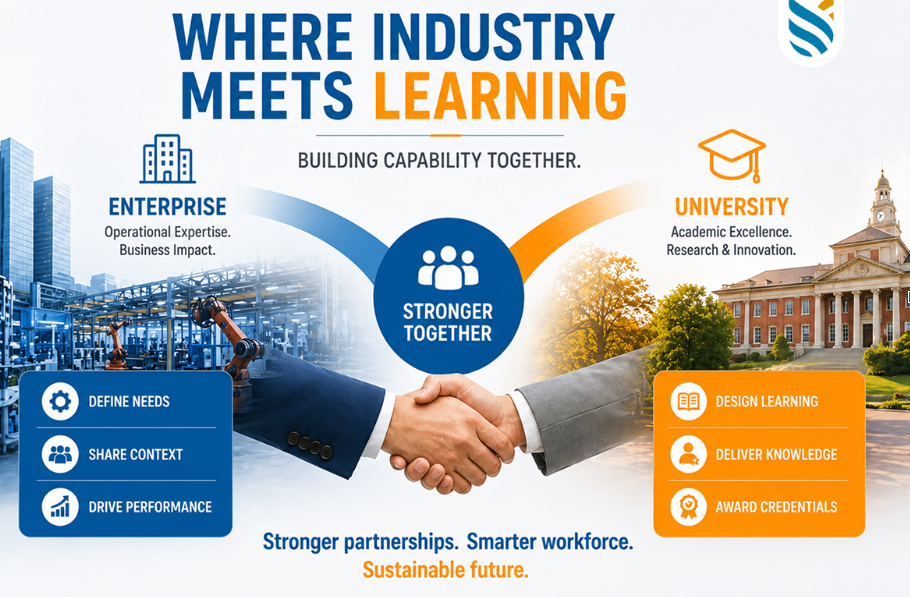
Industry-academia collaboration addresses this directly, and companies doing it with genuine commitment are seeing results that internal programmes alone do not produce.
Why It Produces Better Results Than Internal Training
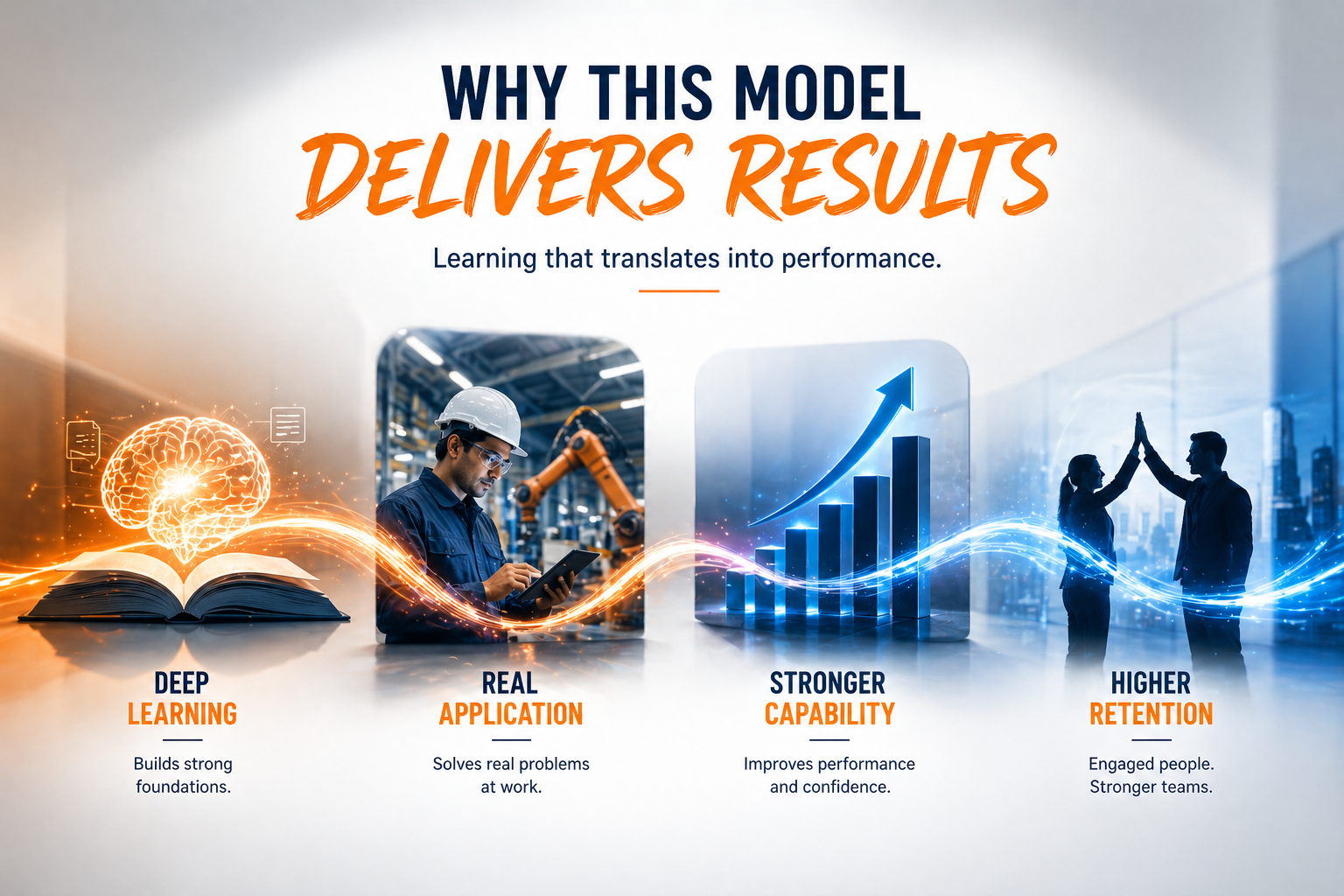
The knowledge goes deeper
Short training programmes even good ones tend to produce awareness rather than capability. New employees understand a concept well enough to discuss it, but not well enough to apply it independently when the situation is unfamiliar or complex.
University-level learning, by design, requires a different level of engagement. Assignments are not multiple-choice questions completed in fifteen minutes. They require sustained thinking, application to real contexts, and the ability to defend reasoning. That process builds a qualitatively different kind of understanding one that holds up under pressure, not just in a training room.
When that rigour is combined with content that is directly relevant to the employee’s actual role because the curriculum was designed with the employer’s input the result is capability that transfers to real performance far more reliably than conventional training tends to produce.
The learning sticks because it is applied immediately
One of the most well-documented problems in corporate training is the transfer gap the distance between what someone learns in a training environment and what they actually do differently back at work. Most training loses most of its impact within weeks, simply because there is no mechanism to apply it before it fades.
Work-integrated academic programmes close this gap structurally. Because assignments and projects are built around real work, application happens as part of the learning process not as an afterthought that may or may not follow it. Employees are not asked to remember something they learned six weeks ago. They are working with it continuously throughout their programme.
Why People Stay Longer When This Is Done Well
Retention is cited consistently as one of the strongest outcomes of corporate-university partnerships, and it is worth understanding why rather than just stating it.
Employees leave organisations for a range of reasons, but one that appears repeatedly across exit data is the sense that their professional development has stalled. When people feel they are not growing, the question of whether to stay becomes easier to answer. A better offer from a competitor does not need to be dramatically bette it just needs to feel like forward movement.
Accredited university qualifications address this in a specific way that internal certificates do not. A qualification from a recognised institution belongs to the employee permanently. It has value outside the organisation that they earned with. When a company facilitates that, they are signalling something meaningful that investment in this person’s development is not conditional on continued employment, and that their growth matters beyond their current job description.
Several factors determine whether this actually drives retention or just produces a credential:
- The programme must be visibly connected to career progression within the company employees need to see where completing it takes them, not just what they will learn.
- Study time and workload must be manageable alongside full-time work programmes that routinely push employees into burnout do not produce loyalty.
- Managers need to actively support participation, not treat learning as a distraction from real work.
- Completion needs to be formally recognised through promotion consideration, pay review, or role development otherwise the signal sent is that the company values the programme optics more than its outcomes.
What Separates Partnerships That Work From Those That Don’t
Corporate–university partnerships tend to fall short when they are treated as one-time initiatives rather than ongoing collaborations. Lasting impact comes from aligning both academic and operational goals over time.
On the company side, the partnerships that work tend to involve real operational access not just funding. Faculty working on applied research problems need contact with actual data, actual processes, and actual people making decisions. Programme designers need honest input from the business about what employees genuinely struggle with, not what looks good in a competency framework. Senior leaders need to be visible sponsors, not distant signatories.
On the university side, effective partners deploy academics who find applied work interesting and who are willing to adapt delivery formats to fit working professionals. A programme designed around the assumption that participants are full-time students with unlimited time for reading and attendance will not survive contact with a cohort of people managing jobs and personal commitments simultaneously.
Structural features that distinguish high-performing partnerships:
- Governance that includes regular review meetings with decision-makers from both sides not just annual check-ins
- Agreed outcome measures that go beyond enrolment numbers to include completion rates, capability assessments, and business impact indicators
- A genuine mechanism for participant feedback to influence programme design, not just satisfy an accreditation requirement.
- Flexibility to update content as the company’s context evolves a curriculum locked for five years will be partially irrelevant by year three
MSU's Enterprise Workforce Development Model
Building a corporate-university partnership is straightforward enough for a cohort of fifty managers. Doing it across thousands of frontline workers, spread across shifts, locations, and job functions, is a different problem entirely and most universities and training providers are not set up to handle it at that scale.
Medhavi Skills University's enterprise model is designed around exactly this challenge. What it offers in practice:
- Programmes built around specific job roles in consultation with the employer not adapted from an existing curriculum but constructed from the requirements of the position itself
- Employees earn nationally recognised diplomas or degrees without stepping away from their roles, so the business keeps its workforce while developing it.
- Role-based assessments and structured skilling pathways that apply consistently across large teams, reducing the uneven training quality that plagues high-volume onboarding
- Integration with existing onboarding, training, and deployment workflows rather than running as a separate initiative that competes for management attention
- Proven application across manufacturing, logistics, healthcare, retail, hospitality, and BFSI sectors where workforce numbers are large, and turnover is a persistent operational cost
For organisations that have been running training as a series of disconnected programmes with no clear thread between them, this is a structural change not an added initiative but a replacement for an approach that was never going to scale.
The Financial Logic
The business case for corporate-university partnership is often presented in terms of retention savings and productivity gains, which are real but difficult to quantify precisely in advance. The clearer financial argument is simpler.
Building advanced technical or professional capability through internal training alone is slow and expensive when you account fully for the cost of programme design, delivery, facilitation, materials, and the cumulative opportunity cost of participant time. For common capabilities leadership, project management, data analysis internal programmes often produce adequate but shallow results at reasonable cost. For specialist, high-stakes, or rapidly evolving capabilities, the economics shift.
University partnerships bring existing infrastructure faculty, research access, assessment design, accreditation that a company would spend years and significant resources building internally. The question is not whether that infrastructure has value. The question is whether the partnership is structured well enough to actually deliver it.
In Closing
Corporate-university collaboration works when both sides treat it as a genuine working relationship rather than a transaction. The company gets access to expertise, infrastructure, and credentialing that it could not efficiently build on its own. The university gets applied research opportunities, curriculum relevance, and a direct connection between what it teaches and what the market actually needs.
Employees get something harder to put a number on: a clear signal that where they are going matters to the organisation they work for backed by a qualification that will follow them regardless of where their career leads. That combination, when it is delivered properly, is one of the more durable retention mechanisms available to employers today.