
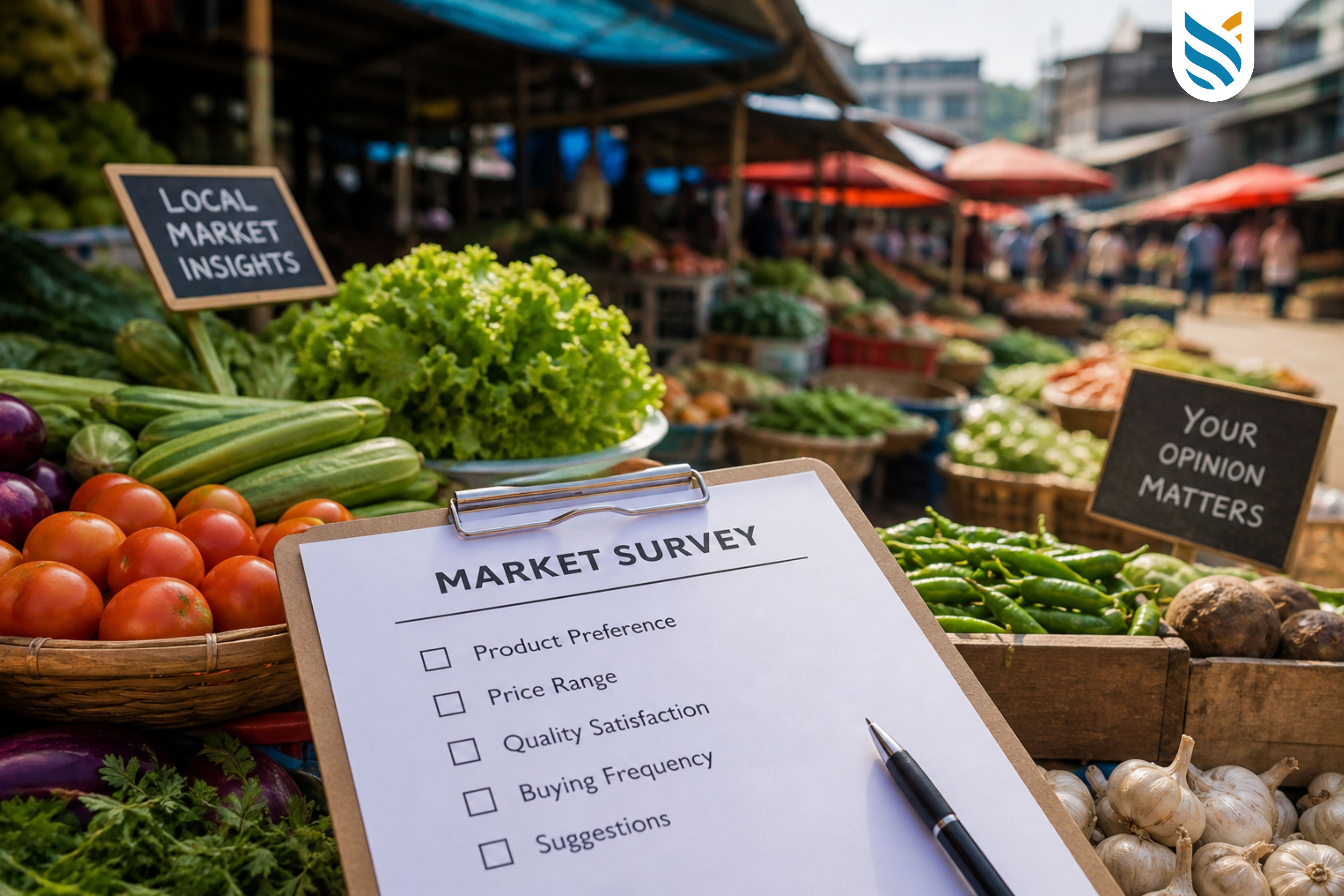
The morning air at Singtam Bazar carries the distinct smell of fresh produce, leafy greens stacked in open crates, root vegetables laid out on worn wooden surfaces, and the sound of vendors calling out prices to early buyers. It is a working market, unhurried and authentic, the kind of place where food begins its journey long before it reaches any kitchen.
On a recent morning, it was also a classroom.
Students from Medhavi Skills University’s Culinary Arts programme arrived not as visitors, but as working learners with a clear academic mission: to conduct a structured market survey, document observations, and translate those insights into better culinary decision-making. The exercise formed part of the university’s Kitchen Operations Skill Drill elective, designed to build real-world competence in sourcing and ingredient selection.
Where Education Meets the Marketplace
The Singtam Bazar market survey was designed as an active field learning exercise, giving students direct exposure to the food supply chain at its origin point.
Located in East Sikkim, Singtam Bazar is a dynamic local market known for its mix of small farmers, regional suppliers, and wholesale vendors serving the hospitality ecosystem. It offers a live view of how ingredients move from source to kitchen, making it an ideal learning environment.
The exercise was faculty-led, with structured pre-visit preparation and post-visit reflection, ensuring that the experience translated into academic and professional learning outcomes.
Why Singtam Bazar? The Educational Logic Behind the Location
The choice of Singtam Bazar was deliberate. It provides access to both retail-level and supply-chain-level insights, something few controlled environments can replicate.
Students observed not just what is sold, but how it is sourced, priced, and negotiated. They also engaged with the regional character of Sikkim’s food ecosystem, understanding how seasonality, geography, and supply influence what ultimately reaches a kitchen.
A professional chef does not only cook. They make decisions, about sourcing, quality, cost, and seasonality. This environment allowed students to begin building that decision-making lens.
| A professional chef does not only cook. They make decisions, about sourcing, quality, cost, and seasonality. Singtam Bazar gave our students the opportunity to begin developing that decision-making lens. |
What Culinary Students Observed and Explored at the Market?
The survey was structured around a set of defined observation tasks, each connected to a specific area of culinary and kitchen management knowledge. Students worked individually and in small groups, documenting their findings systematically.
Produce Quality Assessment
Students examined fresh produce for quality indicators, colour, texture, freshness markers, signs of damage or overhandling, and appropriate storage conditions. They compared produce from different vendors and discussed the variables that account for quality differences in the same category of ingredient.
Price Mapping and Cost Analysis
Students documented the market rates for a range of commonly used ingredients, vegetables, herbs, proteins, dairy, and dry goods, and began constructing a basic cost reference framework. This exercise directly supports their ability to manage food cost percentages and build menu pricing models in professional kitchen environments.
Vendor Interaction and Supplier Relationships
Faculty encouraged students to engage directly with vendors, asking about sourcing origins, seasonal availability, volume pricing, and delivery logistics. This interaction introduced students to the supplier relationship dimension of culinary management, a skill that head chefs and kitchen managers rely on daily.
Seasonal and Regional Ingredient Study
Singtam Bazar''s inventory reflects Sikkim''s seasonal agricultural calendar. Students documented which ingredients were in season, which were arriving from other regions, and what implications seasonal availability has for menu planning and ingredient substitution. This is a foundational competency for any culinary professional working with ingredient-led or seasonal menus.
Importance of Market Research in Culinary Arts Education
The relationship between market knowledge and culinary excellence is not incidental, it is structural. Every professional kitchen operates within a financial framework, and food cost is one of the most significant variables within that framework. A chef who does not understand market pricing cannot build a profitable menu. A kitchen manager who does not know their suppliers cannot negotiate effectively or respond quickly to ingredient shortages.
Beyond cost, market knowledge informs quality. Understanding the difference between a locally grown, seasonal ingredient and an out-of-season one that has been transported over long distances is not just academically interesting, it directly affects the flavour, texture, and nutritional profile of the food that reaches a guest''s plate.
Market surveys, conducted as structured academic exercises, teach culinary students to think about food the way professional chefs do: as a system of decisions, not just a collection of recipes.
Skills Developed Through This Field Activity
| Activity at Market | Skill Developed | Career Application |
| Produce quality assessment | Sensory evaluation, quality benchmarking | Procurement decisions, supplier selection, kitchen quality control |
| Price documentation | Cost tracking, price comparison, numerical literacy | Food cost management, menu pricing, financial reporting |
| Vendor interaction | Professional communication, negotiation awareness, supplier relations | Managing supplier accounts, procurement negotiations, relationship building |
| Seasonal inventory study | Menu planning, ingredient substitution, seasonal literacy | Creating cost-effective, seasonal menus in professional kitchens |
| Comparative analysis across vendors | Critical evaluation, decision-making | Choosing optimal suppliers, building cost-effective procurement strategies |
How Field Trips Shape Better Culinary Professionals
There is a particular kind of learning that happens in real environments that cannot be replicated in any classroom. It is the learning that comes from being present, from seeing, touching, smelling, and interacting with the actual subject of study. For culinary arts students, whose profession is rooted in the physical and sensory, this embodied learning is especially important.
A student who has stood in Singtam Bazar and watched how a restaurant''s head chef selects produce, negotiated a price with a vendor, and understood why certain ingredients cost more in certain months, that student carries a different quality of professional awareness into their career than one who has only read about these processes.
Field trips, designed and executed well, create permanent professional reference points. They are the experiences that students draw upon years later, in real kitchen and management situations, often without consciously recognising that the learning happened in a market one morning during their university years.
Benefits of Practical Learning in Hospitality Education
The broader case for practical, experiential learning in hospitality and culinary education is well established. Hospitality is a performance industry, the quality of the guest experience is determined not by what professionals know in theory, but by what they can execute under real conditions. Universities that recognise this design their programmes accordingly.
Practical learning gives students the opportunity to fail safely, to observe excellence up close, and to build the muscle memory and professional instincts that underpin great hospitality and culinary work. It also accelerates the transition from student to professional, a transition that, in hospitality, is often measured not in months but in the early weeks of a first role.
At Medhavi Skills University, field activities like the Singtam Bazar market survey are not supplementary. They are integral to how the university defines learning, and what it commits to delivering for every student who chooses the MSU experience.
Conclusion: Learning That Goes Beyond the Classroom
On that morning at Singtam Bazar, the students of MSU''s Culinary Arts programme did not just observe a market. They began to understand food as a professional, as something that exists within a system of economics, relationships, seasonality, and quality, long before it becomes a dish.
That understanding is what separates a technically trained cook from a thinking, decision-making culinary professional. And it is exactly what Medhavi Skills University is committed to building, one deliberate, real-world learning experience at a time.