
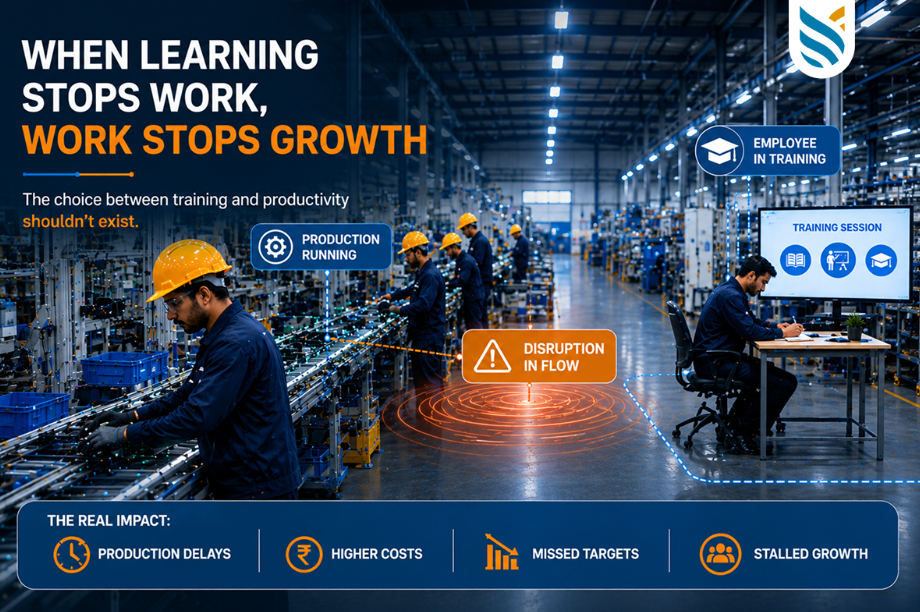
For large-scale enterprises in manufacturing, logistics, and hospitality, the "talent gap" isn't just a buzzword—it’s a daily operational bottleneck. As business models shift and automation becomes the standard, the pressure on workforce development has never been higher. Yet, most leaders are stuck with a frustrating choice: do you keep your production lines running at full capacity, or do you pull your best people off the floor to upgrade their skills?
The reality is that most corporate training programs were designed for office workers, not the frontline. You cannot ask a plant operator or a retail supervisor to "hop on a Zoom call" for three hours or take a week off for a certification. These are the people who keep the lights on. When they stop working, the business stops earning.
This creates a structural ceiling for your most loyal employees. They have years of "dirt-under-the-fingernails" experience, but because they lack formal credentials, they can’t be promoted into management. Medhavi Skills University (MSU) works towards breaking this cycle by integrating higher education directly into the flow of work.
The Problem: Why Frontline Upskilling Stalls at Scale
Large enterprises face a specific set of logistical hurdles that make traditional employee upskilling nearly impossible to scale:
- Geographic and Shift Constraints: Your workforce is likely spread across multiple states and facilities. Standardising high-quality training across three different shifts and ten different locations is a logistical nightmare.
- The Opportunity Cost of Downtime: The math rarely works out in favour of traditional training. If you pull 10% of your workforce for a week-long workshop, your production targets take a hit that the "learning outcome" rarely justifies in the short term.
- The Retention Trap: Training without a credential often leads to "skill leakage." Employees take the new skills you gave them and leave for a 10% raise elsewhere because they don't see a long-term career path tied to their current role.
The MSU Solution: Career Pathways While Working
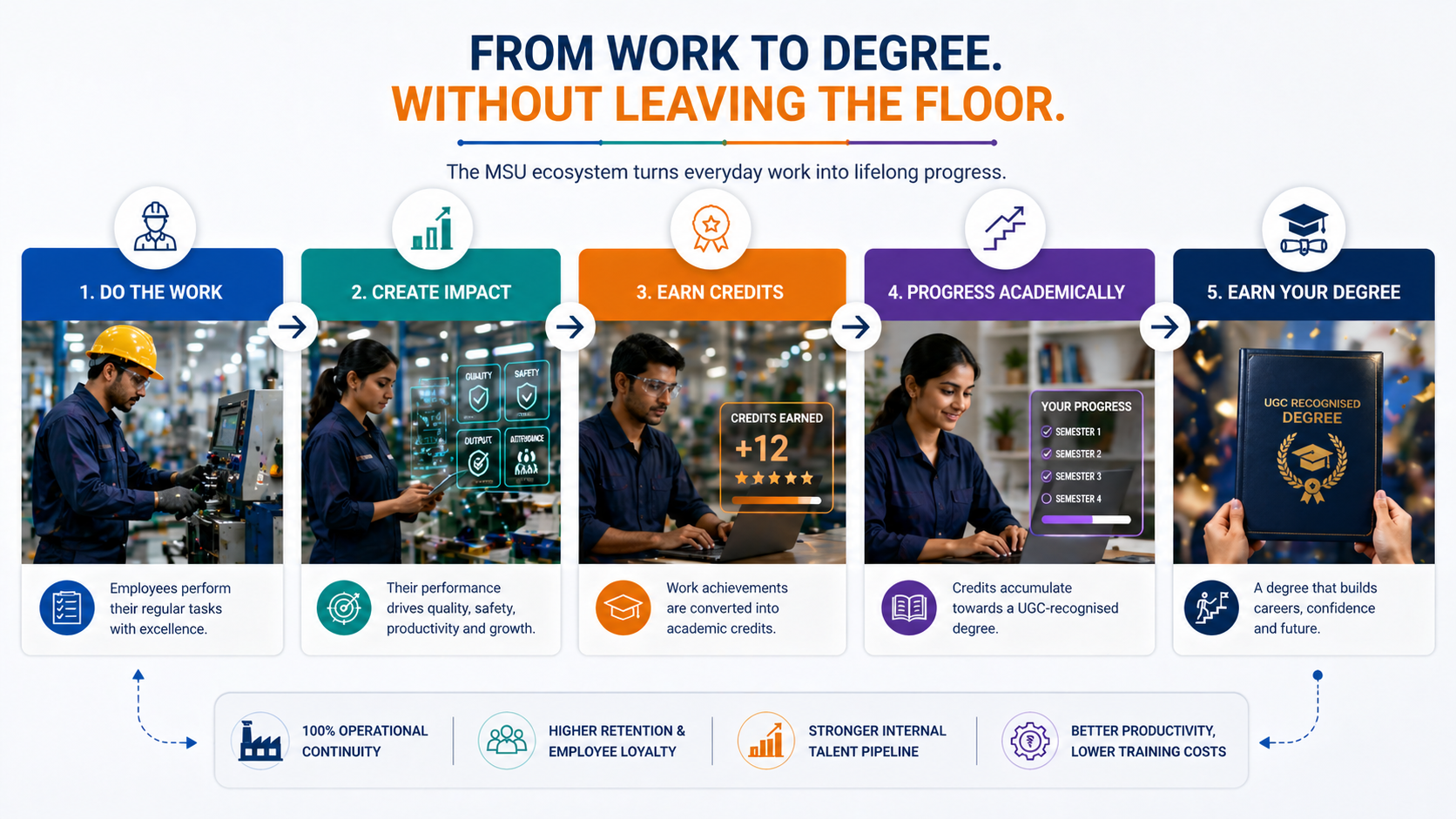
MSU doesn't view the workplace and the classroom as two separate things. Our "Work-Integrated Skill-Based Higher Education" framework allows employees to earn UGC-recognised credentials while they stay on the clock. This isn't just "online school" after hours; it’s a system where the work they do during their shift counts toward their diploma.
Employer Co-Designed Curriculum
Most workforce development initiatives fail because the content is too generic. MSU changes this by letting the employer help write the "textbook."
We sit down with your operations and HR teams to map your company’s specific Standard Operating Procedures (SOPs) to academic modules. If your team needs to master a specific CNC machine or a proprietary logistics software, that mastery becomes a core part of their credential. This ensures that every hour spent "studying" is actually an hour spent becoming better at their specific job.
Recognition of Prior Learning (RPL)
One of the most disrespectful things a company can do to a veteran employee is ask them to sit through a "Basic Safety" course they could teach in their sleep. Our RPL framework acknowledges that experience is a form of education.
We assess the existing skills of your long-term staff and give them academic credit for what they already know. This validates their years of service and significantly shortens the time it takes for them to earn a credential. It’s the fastest way to turn a seasoned technician into a qualified supervisor.
Turning the Production Floor into a Learning Lab
The core differentiator of the MSU model is that the workplace becomes the primary learning environment.
- Credits for Performance: When an employee meets their quality KPIs, follows safety protocols perfectly, or helps troubleshoot a line stoppage, they aren't just being a good employee—they are earning academic credits.
- Parallel Progress: Learning happens in the background of their daily routine. There is no "start" or "stop" to the training. By the time they finish their shift, they are one step closer to earning a UGC-recognised degree or certification.
- Immediate Application: In a typical corporate training program, there is a massive gap between learning theory and using it. At MSU, the gap is zero. An employee learns a process in the morning and applies it on the line that afternoon.
The Business Case: From Cost Centre to Talent Pipeline
For a CHRO or a COO, this shift moves employee upskilling from the "expense" column to the "asset" column.
Reduced External Hiring. Most companies spend a fortune on headhunters and onboarding for mid-level managers. By credentialing your own frontline, you build an internal pipeline of people who already know your culture, your machines, and your customers. They are ready to lead on day one because they’ve been there for years.
Structural Retention When a worker knows that staying with their company is the only way to finish their degree, they don't leave for a few extra rupees at the factory next door. You are offering them social mobility, not just a paycheck. This deeply embeds talent within your organisation.
Operational Continuity Because our model is parallel to work, you don't have to juggle shift schedules to make room for classes. You maintain seamless operational uptime while simultaneously upgrading the collective intelligence of your workforce.
Conclusion: Future-Proofing Your Frontline
The era of the "unskilled" frontline worker is over. To compete today, every person on your floor needs to be a continuous learner. But you can't build a learning culture if the learning itself is an obstacle to the work.
Medhavi Skills University provides the infrastructure to turn your existing operations into a talent engine. We help you scale your training programs without the overhead, credential your staff without the downtime, and build a leadership pipeline from the ground up.
It’s time to stop choosing between production and progress. With MSU, you can have both